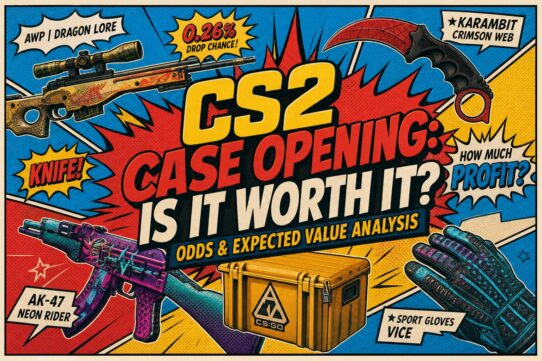




Finding the best CS2 cases to invest in 2026 requires more than scrolling through trending Reddit threads or copying a content creator’s portfolio. The skin economy has matured, and with roughly forty cases now released, each one carries a distinct combination of supply dynamics, knife pools, and skin demand that determines whether it appreciates or stagnates on the Steam Market, making CS2 case investment a highly specialized niche.
The single most important distinction you can make as a CS2 case investor is separating “fun to open” from “smart to hold,” because the math behind each decision is completely different. Every case shares identical rarity tier probabilities, yet the contents, supply trajectory, and market sentiment vary wildly. That gap is where real value lives.
This guide walks you through the criteria that actually matter before you spend a dollar, ranks the strongest case categories for 2026, explains what inside a case drives long-term demand, and outlines a practical strategy for building your inventory without unnecessary risk. If you are a budget-conscious player looking to grow your CS2 collection without real-money deposits, platforms like Rewardly let you earn Coins through surveys, offerwall tasks, and referrals, then redeem them for CS2 skins and Steam gift cards at no markup.
Key Takeaways
- Discontinued and legacy cases with shrinking supply consistently outperform active drop pool cases as long-term holds.
- A case’s knife and glove pool, not just its covert skins, is the primary driver of sustained market demand.
- Separating unboxing ROI from investment value protects you from buying cases that are popular to open but poor to hold.
How to Judge Investment Value Before You Buy
Case investment decisions come down to three measurable factors: whether the case’s supply is growing or shrinking, how liquid it is on the Steam Market, and whether the case price leaves room for appreciation without being propped up by hype alone.
Why Supply, Liquidity, and Case Price Matter More Than Hype
Supply is the foundation. A case still in the prime drop pool receives thousands of new units every week, which puts constant downward pressure on price. Once Valve removes a case from active drops, the total circulating supply can only decrease as people open or trade-lock them.
Liquidity tells you how easily you can exit your position. A case with high daily volume on the Steam Market lets you sell without waiting days for a buyer. Low-volume cases may appreciate on paper, but the spread between buy and sell orders can eat into your gains.
Case price at the time of purchase matters more than most people think. Buying a case at $0.10 that rises to $0.50 is a 400% return. Buying a case at $5.00 that rises to $8.00 is a 60% return. Entry price directly determines your ROI ceiling.
The Difference Between Unboxing ROI and Long-Term Value
Every CS2 case shares the same rarity probabilities and drop rates. Mil-Spec skins drop about 79.92% of the time, and knives or gloves appear at roughly 0.26%. When hunting for the best CS2 cases to open, unboxing ROI measures the average return you get relative to the key cost plus the case price.
Most cases return between 50% and 75% of total opening cost on average. That means you lose money opening cases over a large sample.
Long-term investment value, by contrast, ignores what is inside the case entirely. It tracks whether the sealed case itself appreciates. A case with terrible unboxing ROI can still be a strong investment if supply is drying up and demand remains steady.
How Drop Pools Shape Scarcity in 2026
Valve maintains two drop tiers for Prime Status players. The prime drop pool currently includes newer cases like the Kilowatt Case, Revolution Case, Dreams & Nightmares Case, and sealed terminals. These cases drop frequently in weekly care packages.
The rare drop pool historically included older cases at roughly a 1% chance per drop. Community data suggests rare drops may have effectively stopped in late 2025, which means many legacy cases and discontinued cases are no longer entering the market at all.
This shift is significant. Cases that once trickled in through rare drops are now functionally finite items, and that accelerates scarcity.
The Strongest Case Types to Watch in 2026
Not all CS2 cases belong in the same conversation. Active drop cases, discontinued cases, and legacy collector cases each carry different risk profiles and timelines for appreciation.
Active Drop Cases With Speculative Upside
Cases currently in the prime drop pool are cheap. That low entry price is their main appeal, but high ongoing supply works against near-term gains.
- Kilowatt Case (~$0.22 to $0.60): The first case designed specifically for CS2. It features a solid skin lineup and desirable knife options. At its current price, the downside risk is minimal.
- Revolution Case (~$0.10 to $0.20): Extremely affordable with decent skins. Worth accumulating if you believe it will leave the drop pool within the next year.
- Dreams and Nightmares Case (~$0.10 to $0.15): Contains one of the most recognizable covert AK-47 skins. Its low price makes it an approachable entry for new investors.
- Sealed Genesis Terminal (~volatile pricing): New enough that the market is still finding a fair price. Higher risk, but sealed terminals have a unique armory-based distribution that limits supply differently.
- Gallery Case (~$0.90): An armory case with the Kukri Knife and a modern skin set. Its distribution differs from standard drops, which could accelerate scarcity.
The speculation here is straightforward: you are betting that Valve will eventually rotate these cases out of the active pool, cutting off new supply.
Discontinued Cases With Proven Scarcity
These cases no longer drop in-game and have a documented track record of price increases:
- Operation Wildfire Case (~$3.95 to $5.00): Features the Bowie Knife pool and consistently ranks near the top of ROI calculators.
- Operation Phoenix Case: A long-standing favorite with strong community recognition and steady demand.
- Operation Hydra Case: One of the more expensive discontinued cases, with glove drops that maintain collector interest.
- Snakebite Case (~mid-range pricing): Contains the coveted Butterfly Knife and glove drops. Supply is decreasing steadily.
- Fracture Case (~$0.59): Discontinued and still affordable, making it a popular budget pick with reasonable upside.
Discontinued cases generally carry less downside risk because their supply curve only moves in one direction.
Legacy Cases Best Suited for Collectors
The oldest CS cases occupy a different part of the market entirely. These are collector-grade items with prices that reflect extreme scarcity rather than practical unboxing logic.
- Bravo Case: One of the original operation cases. Prices are high, appreciation is slow in percentage terms, but the floor is well established.
- CS Weapon Case, CS Weapon Case 2, and CS Weapon Case 3: Historic significance and tiny remaining supply. These are the blue-chip assets of the CS2 economy.
- Winter Offensive Case and eSports 2013 Winter Case: Seasonal nostalgia and limited surviving stock.
- Operation Vanguard Weapon Case, Shadow Case, Falchion Case, and Prisma Case: Mid-tier legacy options that sit between budget picks and collector-grade rarities.
Buying legacy cases is a capital-intensive strategy. The percentage returns may be lower, but the absolute dollar risk of a major price drop is also lower because the market has already priced in their scarcity.
What Inside the Case Actually Drives Demand
Even though case investment focuses on the sealed item itself, the skins, knives, and gloves inside determine how many people want to open it, which directly influences demand and price velocity.
Knife Pools That Keep Cases Relevant
The knife or glove pool is the single biggest demand driver for any case. Cases with rare knives that carry broad appeal tend to hold attention and trade volume much longer than cases with niche options.
High-demand knife types include:
- Butterfly Knife: Consistently the most popular knife in the game by trade volume and price.
- Karambit: A perennial favorite among competitive players and collectors.
- M9 Bayonet: Strong demand across all finish types.
- Kukri Knife: Newer to the scene, but already a sought-after pull.
- Skeleton Knife and Nomad Knife: Growing in popularity, especially in mid-tier finishes.
Cases featuring the Bowie Knife, Falchion Knife, Shadow Daggers, Ursus, or Navaja are rarely considered the best cases to open because those knives carry smaller price premiums. That reduced demand can slow appreciation.
Glove drops, available in select cases like the Hydra Case and Snakebite Case, add a secondary layer of rare special item demand that can meaningfully boost a case’s market relevance.
Popular Finishes and High-Demand Skins
Within each knife pool, the finish determines the actual market value of a pull. The most valuable finishes tend to be:
- Doppler and Gamma Doppler (especially Phase 2 and Phase 4)
- Marble Fade
- Tiger Tooth
- Case Hardened (especially rare blue gem patterns)
- Autotronic
On the skin side, coverts and classified skins with broad name recognition sustain opening demand. The AK-47 Fuel Injector, for example, keeps its parent case relevant years after release. Even a strong Mil-Spec or Restricted lineup can elevate a case’s profile because more people open it, which removes supply from the sealed market.
Why Lower-Tier Skins Still Affect Market Performance
You might assume that Mil-Spec and Restricted skins are irrelevant to case investment. They are not.
Cases with desirable lower-tier skins attract more openers. More openers means more sealed cases leave circulation. That accelerates the supply decrease.
Additionally, trade-up contract demand for certain Mil-Spec and Restricted skins can create a persistent floor of buying pressure on the case itself. If a particular blue skin is a key input in a profitable trade-up path, people will keep opening or buying that case specifically to acquire it.
Float value distribution across a case’s skin pool also matters. Skins with narrow float ranges or factory new scarcity tend to hold elevated prices, which sustains opening interest.
Building a Safer Gamer-First Strategy
Treating CS2 cases purely as financial instruments is a fast track to frustration. A gamer-first approach means you enjoy the ecosystem while making decisions that protect your budget and build real inventory value over time.
When to Hold Cases and When to Buy Skins Directly
If your goal is to own a specific skin, buying it directly on the Steam Market is almost always cheaper than opening cases to find it. The math is clear: with average unboxing returns of 50% to 75%, you spend more on keys and cases than the skin costs outright.
Hold cases when you believe the sealed case will appreciate. Buy skins directly when you want to use them in-game. Mixing the two is where most players waste money.
Using Market Tools Without Overrelying on Them
A trade-up calculator can show you expected value and odds for turning lower-tier skins into higher-tier ones. Case ROI trackers help you compare unboxing returns across all available cases. These tools are useful for filtering out clearly bad decisions.
The limitation is that past performance on the Steam Market does not guarantee future results. Valve can add cases back to drop pools, introduce new operations, or change market mechanics at any time. Use tools to inform your decisions, not to replace your own judgment.
Where Rewardly Fits for Budget-Conscious CS2 Players
Not every player has spare cash to buy cases or skins directly. Rewardly offers a practical alternative. You earn Coins by completing surveys, offerwall tasks, watching videos, and referring friends. Those Coins convert at a flat rate of 1,000 Coins to $1 USD, and you can redeem them for CS2 skins at Steam Community Market value with no markup, or for Steam gift cards at face value.
The minimum redemption threshold is just $5 worth of Coins, and no real-money deposits are required. For players who want to grow their CS2 inventory without dipping into their bank account, this is one of the more responsible paths available.
Frequently Asked Questions
Which CS2 cases are showing the strongest long-term price trends right now?
Discontinued cases like the Operation Wildfire Case, Snakebite Case, and Fracture Case have shown steady upward price movement as their supply continues to shrink. Legacy cases such as the Bravo Case and CS Weapon Case remain strong, though their high price points mean slower percentage growth.
What factors typically make a CS2 case appreciate in value over time?
Three factors dominate: removal from the active drop pool (which caps supply), a desirable knife or glove pool (which sustains opening demand), and recognizable skins inside (which keep trade volume high). Cases that check all three boxes tend to outperform over multi-year horizons.
How can I check whether a case’s supply is still increasing or becoming scarce?
Track the case’s listing count on the Steam Market over several weeks. If the number of active listings is declining while the price is stable or rising, supply is tightening. Community data and third-party trackers also report estimated drop pool status, which tells you whether new units are still entering circulation.
What is the safest strategy for diversifying across multiple CS2 cases?
Spread your budget across a mix of low-cost active drop cases, mid-priced discontinued cases, and one or two higher-priced legacy options. This balances high upside potential against lower downside risk. Avoid putting all of your budget into a single case, no matter how promising it looks when choosing the best cs2 cases to invest in 2026.
How do in-game drops, operations, and market changes affect case investment risk?
Valve controls the drop pool, and any rotation can instantly change supply dynamics. A new operation could introduce cases that compete for attention, or Valve could move a currently active case into the rare drop pool. These unpredictable events are the single biggest source of risk in case investing.
What are the most reliable ways to buy, store, and later sell cases while minimizing fees and fraud risk?
The Steam Community Market is the most secure place to buy and sell, though Valve takes a combined fee of roughly 15% on each transaction. Storing cases in your Steam inventory carries no cost. To minimize fees when selling, consider timing your sales around demand spikes, such as major tournament weekends or new operation launches, when buyer activity is highest.