
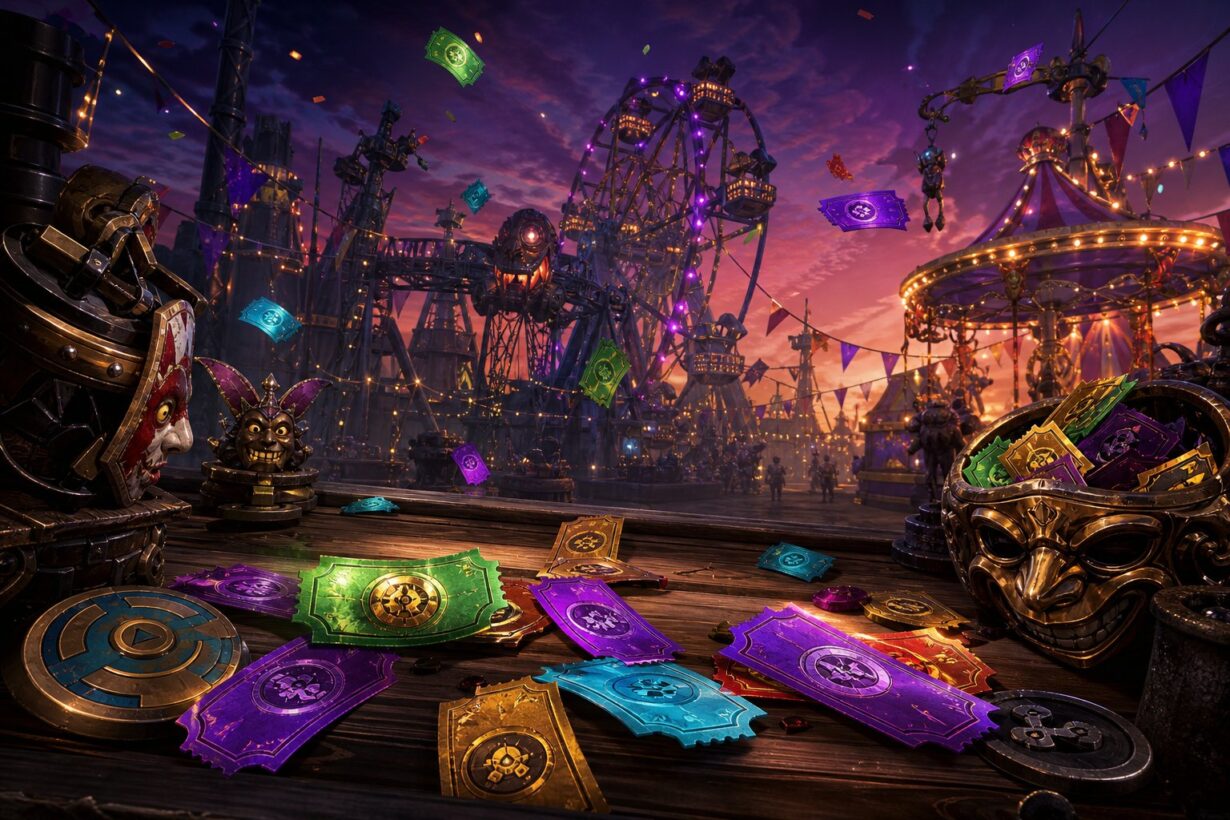

The July 1, 2026 patch for Dota 2’s Dark Carnival event changed how you earn event progression in a way that matters more than a typical bug-fix pass. Regular and Turbo matches now award Scrap tickets regardless of whether you win or lose, and six Scrap can be traded for any Hero ticket you choose. This dota 2 dark carnival scrap tickets update reshapes how you plan sessions, interact with the Ticket Trader, and decide which queue to join.
Before this update, Dark Carnival punished you for losing in Turbo with zero event progress and forced awkward hero picks just to chase the right ticket colors. The Scrap system acts as a reliable safety net: even when your direct ticket drops are messy, a short stretch of normal play can patch the gap. This guide breaks down the exact math, the time-value tradeoff between Regular and Turbo queues, the rewards like the Treasure of Wonders, and how to translate all of it into faster event progress. We also cover the Ranked Roles quality-of-life fix that helps you unlock the Candy Shop faster.
Key Takeaways
- Regular matches award 2 Scrap and Turbo matches award 1 Scrap per game, win or lose, so every match now contributes to event progress.
- Three Regular games or six Turbo games produce one Hero ticket of your choice, letting you skip bad ticket-color RNG entirely.
- The Ranked Roles fix now requires only one high-demand role instead of two, making solo queue less punishing for support-averse players.
What Changed In The July 1, 2026 Patch
The patch is small in scope but large in behavioral impact. It introduces guaranteed Scrap from every standard match and removes the win/loss gate from event reward flow entirely. Many players are using this to speed through the story featuring Ringmaster. The Ranked Roles tweak shipped alongside it, though most coverage focused on the Dark Carnival changes.
Guaranteed Scrap From Regular Matches
Every Regular (non-Turbo) match you complete now awards 2 Scrap tickets. This applies to all standard matchmaking modes, including Ranked. As Valve’s official patch notes confirm, Scrap is rewarded on top of your normal hero-specific ticket drops, not instead of them.
Two Scrap per game means three Regular matches equal one Hero ticket of your choice. That is a meaningful fallback. If your hero pool does not align with the ticket colors a particular Train node requires, you no longer need to force uncomfortable picks or stall your progress entirely.
Turbo Match Reward Rules
Turbo games now award 1 Scrap per match. At launch, a Turbo loss gave you nothing for event progress. That made the mode a risky choice: fast games were appealing for grinding, but a loss streak could waste an entire session.
One Scrap per Turbo match is half the rate of Regular, but Turbo games run 15 to 20 minutes. This makes it a viable way to grind for a Candy Sack. The time-per-ticket math is closer than it first appears, and the section below covers the exact tradeoff.
Why Wins And Losses No Longer Matter For Scrap
The SteamDB patch entry states it plainly: “Scrap is rewarded regardless of winning or losing.” This is the single most important line in the update.
Before July 1, event progress was partially gated behind wins. A Turbo loss gave zero fallback. A Regular loss gave only one random ticket out of three possible colors. That system incentivized dodging drafts, picking heroes you could not play well, and tilting harder over losses because progress was on the line. Removing the win/loss condition from Scrap does not make wins worthless; you still get better direct ticket drops from a win. It just means a loss is never a total waste anymore.
How The Scrap Ticket System Works
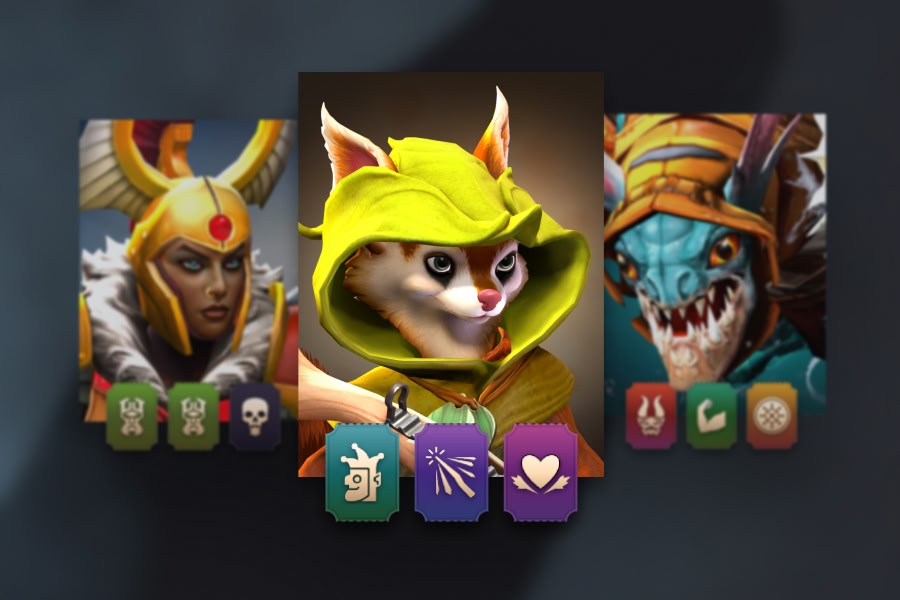
Scrap is a secondary currency layered on top of Dark Carnival’s hero-specific ticket system. It exists to solve one problem: letting you choose your ticket color via the Ticket Trader instead of relying on hero-drop RNG. This is essential for unlocking the Treasure of Wonders. The result is a direct reduction in wasted games.
What Scrap Is Used For
Scrap tickets serve exactly one purpose. You collect them and trade them for Hero tickets at the Ticket Trader. They cannot be used to open Train nodes directly, purchase Candy Shop items, or interact with The Oracle. Think of Scrap as a universal adapter that converts raw playtime into the specific ticket color you are missing.
According to a Dark Carnival walkthrough by Cyberscore, each hero in the event is tied to three ticket types. Wins give one of each; losses give one random ticket. Scrap bypasses that randomness entirely when you have enough of it.
Converting 6 Scrap Into A Hero Ticket
The exchange rate is fixed: 6 Scrap for 1 Hero ticket of your choice. You make this trade inside the Dark Carnival event UI. There is no cooldown, no daily cap mentioned in the patch notes, and no diminishing returns.
Here is how the math looks across modes:
| Mode | Scrap Per Match | Matches Per Hero Ticket | Typical Match Length |
| Regular | 2 | 3 | 35–45 minutes |
| Turbo | 1 | 6 | 15–20 minutes |
Three Regular games is the fastest raw-match path. Six Turbo games takes more matches but can be faster in real clock time depending on queue and draft duration.
Choosing The Hero Ticket You Actually Want
When you convert Scrap, you select the exact Hero ticket color you need. This is the mechanic’s core value. Instead of forcing yourself onto an uncomfortable hero because its ticket type matches your current Train node requirement, you play your comfort pool and patch the gap with Scrap.
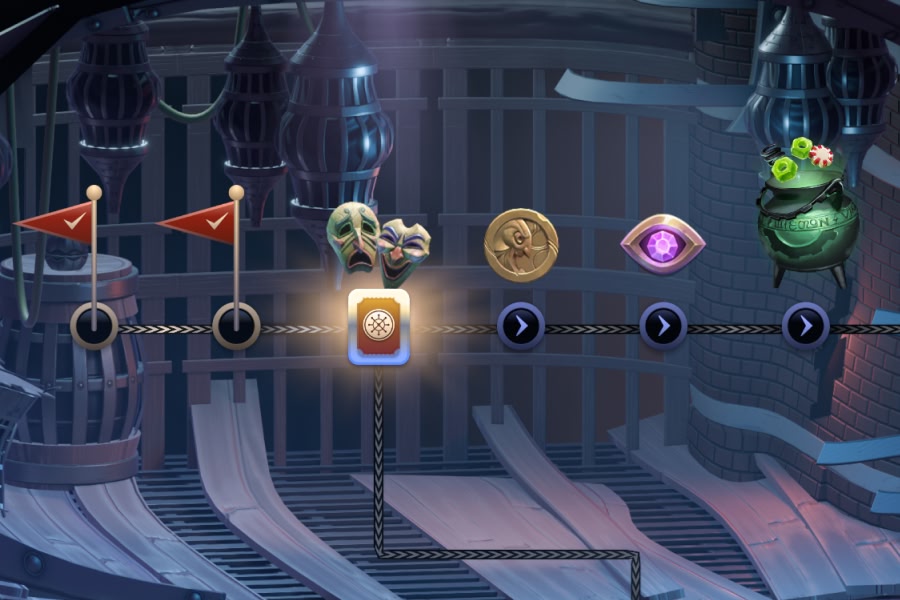
The Hero Filter tooltip added in the same patch now displays which ticket type your next node requires. Pair that tooltip with your Scrap balance to decide whether you need to queue a specific hero or can just play three more Regular games on whatever you want.
Fastest Ways To Earn Scrap Efficiently
Speed matters because Dark Carnival is a time-limited event. Your play hours are finite, especially if you are hunting for Discount Coins. The right queue choice depends on how much time you have and whether you want to play as Ringmaster.
Regular Matches Versus Turbo For Time Value
Regular matches yield 2 Scrap in roughly 40 minutes including queue. Turbo matches yield 1 Scrap in roughly 20 minutes. On paper, the per-minute Scrap rate is nearly identical for event progression. Both modes help you earn Candyworks re-rolls by moving through the map.
The tiebreaker is what else each mode gives you. Regular games also produce better direct ticket drops (all three colors on a win) and count toward Ranked progression. Turbo gives you faster cycles but weaker direct drops and no MMR movement. If you need both Scrap and direct tickets, Regular wins. If you only need Scrap to patch a specific missing color, Turbo’s faster cycle time can be more efficient.
Best Session Planning For Consistent Progress
Plan sessions around your ticket deficit, not around a target number of games. Check the Hero Filter tooltip before you queue. If your next node needs a ticket color you can earn directly from a comfort hero, queue that hero in Regular. If the color requires a hero you are bad at, skip it and plan to earn 6 Scrap instead.
A clean session structure looks like this:
- Check which ticket colors you are missing via the Hero Filter tooltip.
- Queue comfort heroes that match at least one needed color in Regular.
- After each game, reassess. If the remaining gap is one ticket, decide whether one more targeted game or three Scrap-earning games is faster.
- Use Turbo only when you need pure Scrap volume and have no color-aligned comfort picks.
When To Prioritize Volume Over Match Stakes
Volume matters most when you are multiple Hero tickets behind on a path and none of your strong heroes align with the needed colors. In that situation, the fastest approach is to queue Turbo repeatedly on any hero you enjoy, accumulate Scrap, and convert.
This is also the right call when you are tilted, on a loss streak, or playing during off-peak hours with long Regular queue times. Turbo queues pop faster, games resolve faster, and because Scrap is win/loss-agnostic, your mental state does not tax your progress.
Optimization Tips For Different Player Types
Not every player has the same goals or the same amount of time. The Scrap system benefits everyone, but the optimal approach shifts depending on your profile. Some focus on the Treasure of Wonders, while others just want more Candy sacks.
Casual Players With Limited Time
If you play two or three games per day, Regular matches are almost always your best option. Each game gives you 2 Scrap plus direct ticket drops. Three Regular games in one session can net you one Hero ticket from the Ticket Trader. This helps you reach nodes that award a Candy Sack or other rare items.
Do not waste limited sessions on Turbo unless you genuinely prefer the mode. The 2x Scrap rate in Regular makes every game count more, and you still get MMR and normal match quality.
Grinders Chasing Multiple Hero Tickets
If you are trying to clear multiple Train nodes per day, mix modes deliberately. Start with Regular matches on heroes whose ticket colors align with your path. Once your direct-drop needs are handled, switch to Turbo for pure Scrap farming to cover remaining gaps.
A detailed breakdown on TeamSmurf outlines a similar approach: use comfort heroes in serious matches, then clean up with Scrap conversion. This prevents the old problem of forcing bad hero picks in Ranked just to chase a ticket color.
Players Who Want Predictable Event Progress
Some players do not care about speed. They care about consistency. If you want to know exactly how many games it takes to reach a specific node, Scrap makes that calculation straightforward.
Count the Hero tickets you still need. Multiply by 3 (for Regular) or 6 (for Turbo). That is your guaranteed floor, ignoring any direct ticket drops that might speed things up. This predictability is the real upgrade over the launch system, where a string of losses on the wrong heroes could leave you with nothing to show for an evening.
Ranked Roles Quality-Of-Life Fix Explained
The same July 1 patch quietly changed how Ranked Roles queue games work. This fix affects every Ranked player below Immortal, and it received far less attention than the Scrap changes.
The Old Requirement Versus The New Rule
Before the patch, you needed to select both high-demand roles (typically Hard Support and Soft Support) to avoid spending a Role Queue Game token. That meant queuing for two roles you might not want to play, just to keep your token balance healthy.
After the patch, you only need to select one high-demand role. As a breakdown on the Ranked Roles change explains, this cuts the cost of maintaining your queue flexibility in half. This is a huge win for those trying to earn Candyworks re-rolls in ranked.
How One High-Demand Role Protects A Role Queue Game
By selecting a single high-demand role alongside your preferred core roles, you avoid burning a Role Queue Game token. You might still get assigned the support role occasionally, but the odds are lower than when you were forced to select two support slots.
This means you can queue for, say, Mid and Hard Support, and if you land Mid you keep your token. The old system required you to also check Soft Support, which doubled your chance of getting pulled into a role you did not want.
Who Benefits Most From The Change
Solo queue players in the Archon-to-Divine bracket benefit the most. These brackets have the highest demand for support roles and the longest queue times when you only select core positions. The fix lets you maintain a healthy Role Queue Game balance without committing to two support roles. This makes it easier to focus on event progression during your limited playtime.
Players who already queue all five roles see no difference. Players who exclusively queue one core role and refuse to flex also see no difference, since they will still burn tokens. The sweet spot is the player who is willing to flex to one support role but resented being forced into two.
What This Update Means For Player Behavior
Patch changes are only interesting when they alter what players actually do in queue. This update shifts behavior in three measurable ways.
Lower Pressure To Win Every Match
When Scrap drops regardless of match outcome, the emotional weight of each game decreases. You no longer sit through a 40-minute loss knowing your event progression is stalled. Wins still produce better direct ticket drops and more Discount Coins. But the sting of a loss is reduced because 2 Scrap always lands in your inventory.
This matters most for Ranked players who were picking event heroes over comfort heroes to chase ticket colors. With Scrap as a fallback, you can pick your best hero, protect your MMR, and still make progress.
More Incentive To Queue Turbo
Before July 1, Turbo was a trap for event progress if you lost. Now it is a legitimate farming lane. Expect Turbo queue times to shorten as more players use it for Scrap accumulation, especially during late-night or off-peak hours.
The mode’s popularity spike may also shift Turbo’s meta slightly. Players queuing purely for Scrap are less likely to draft tryhard compositions and more likely to experiment, which makes Turbo feel more casual than it already was.
How Guaranteed Rewards Change Engagement
Guaranteed progress mechanics tend to increase session length. When every game produces a visible reward, players are more likely to queue “one more match” because the marginal value is clear and predictable. Valve likely understands this; as noted by community discussions on Steam, the Scrap system is described as a “consolation prize” rather than a nerf to existing drops.
The psychological shift is real. Instead of gambling on whether a game will count toward your event path, you know it will. That certainty keeps players in the queue longer, hoping to unlock a candy sack or new skins. This predictability makes the Candy Shop feel more attainable for everyone.
Guaranteed Progress Versus Chance-Based Rewards
The Scrap update is part of a broader trend in live-service games: moving away from pure RNG reward gates and toward hybrid systems where guaranteed progress runs alongside randomized drops.
Why Predictable Drops Feel Better For Planning
When you can calculate exactly how many games separate you from a specific reward, you plan around it. You decide before queuing whether tonight is a three-game or a six-game session. You know what you will walk away with.
Chance-based systems produce the opposite effect. You cannot plan around randomness, so sessions feel open-ended and potentially wasteful. The Scrap system keeps the randomized direct ticket drops for wins but adds a predictable floor so that no session ends at zero.
The Appeal Of Transparent Earning Systems
Transparency in reward systems builds trust. When you see “2 Scrap per Regular game, 6 Scrap equals 1 Hero ticket,” you can audit the math yourself. There is no hidden modifier, no secret cooldown, no ambiguity about whether a game counted.
This same principle applies outside of Dota 2. Any platform that tells you exactly what you earn per action and exactly what it costs to redeem removes the anxiety of opaque reward loops. Players and users gravitate toward systems where they can verify the value exchange.
A Natural Comparison To Rewardly
If you appreciate Dark Carnival’s shift toward guaranteed, calculable progress, the same logic applies to how you earn rewards outside the game. Rewardly operates on a similar transparency principle: you earn Coins through surveys, offerwall tasks, videos, and referrals at a flat rate of 1,000 Coins per $1 USD, with no deposits and no randomness in payout. Those Coins can be redeemed directly for Dota 2 skins at Steam Market value or gift cards at face value, with a $5 minimum threshold.
The parallel is straightforward. Scrap gives you a predictable path to a Hero ticket; Rewardly gives you a predictable path to in-game items. Both systems let you calculate your progress in advance, and neither requires you to gamble.
Practical Takeaways For Event Progress
Knowing the patch details matters less than knowing what to do with them. This section distills the update into direct actions.
Best Short-Term Play Strategy
For the next week, focus on Regular matches with comfort heroes. You earn 2 Scrap per game, plus direct ticket drops that may align with your current Train node. Check the Hero Filter tooltip before every queue to see if you can double up on direct drops and Scrap in the same game.
If you hit a ticket-color wall, switch to Turbo and grind six quick games for one chosen Hero ticket. Do not overthink it. The system is designed to catch you up; use it.
Mistakes To Avoid While Farming Scrap
Do not force hero picks in Ranked just for ticket colors. The Scrap system exists precisely so you can avoid this. Forcing a hero you play poorly costs you MMR and often costs you the game, which means worse direct ticket drops on top of the rating loss.
Do not ignore the Candyworks duplicate indicator. Rolling into a duplicate wastes resources that could have gone toward a new item in the Candy Shop. Also, keep track of your Candyworks re-rolls. Do not skip co-op bot matches if you need Seeing Stones; the patch restored that reward path and it is the safest daily Oracle value source.
Who Gets The Most Value From This Update
Players who felt stuck at launch because their hero pool did not match the event’s ticket requirements get the largest quality-of-life boost. You can now brute-force any ticket color gap with three Regular games or six Turbo games, regardless of which heroes you play.
Ranked grinders who refused to sacrifice MMR for event cosmetics also benefit significantly. The combination of guaranteed Scrap and the Ranked Roles fix means you can protect your rating, flex one support role without burning tokens, and still make steady Dark Carnival progress every session.
Frequently Asked Questions
When does the latest update add or change Scrap Tickets, and what patch notes mention it?
The Scrap ticket system was introduced in the July 1, 2026 Dota 2 patch. Valve’s official notes confirm that Regular and Turbo games now reward Scrap tickets. These are convertible into a Hero ticket of your choice at the Ticket Trader. This dota 2 dark carnival scrap tickets update was added specifically to address event progression friction.
How do you earn Scrap Tickets after the most recent update?
You earn 2 Scrap per Regular match and 1 Scrap per Turbo match, regardless of whether you win or lose. Scrap drops automatically at the end of each completed game alongside your normal hero-specific ticket drops.
What can Scrap Tickets be redeemed for in the event store, and have the rewards changed?
Scrap Tickets can only be traded for Hero tickets at the Ticket Trader. You choose the specific Hero ticket color you want. This helps you move through the map toward the Treasure of Wonders. No other Scrap redemption options exist as of this update.
Why are Scrap Tickets not dropping after matches, and how can you fix it?
If Scrap is not appearing after a match, confirm you are playing Regular or Turbo matchmaking, not custom lobbies or other non-standard modes. A bug fix for ticket drops not being issued was deployed shortly after the event launched. Restarting your Dota 2 client and checking for pending updates usually resolves lingering issues.
Do Scrap Tickets expire or reset when the event ends or a new update arrives?
Valve has not stated an explicit expiration date for Scrap Tickets, but Dark Carnival is a time-limited event that launched on June 26, 2026. It is safe to assume all event currencies, including Scrap, will become unusable once the event concludes. Convert your Scrap into Hero tickets before the event ends.
Are Scrap Ticket drops affected by game mode, win/loss, party size, or weekly limits?
Scrap drops are affected by game mode: Regular awards 2, Turbo awards 1. Win or loss does not matter. No weekly cap or party-size restriction has been mentioned in the patch notes or community discussions. Co-op bot matches have not been confirmed to award Scrap; use those primarily for Seeing Stones. However, playing as Ringmaster in these matches can be a good way to practice before heading into regular matches to earn Discount Coins.