
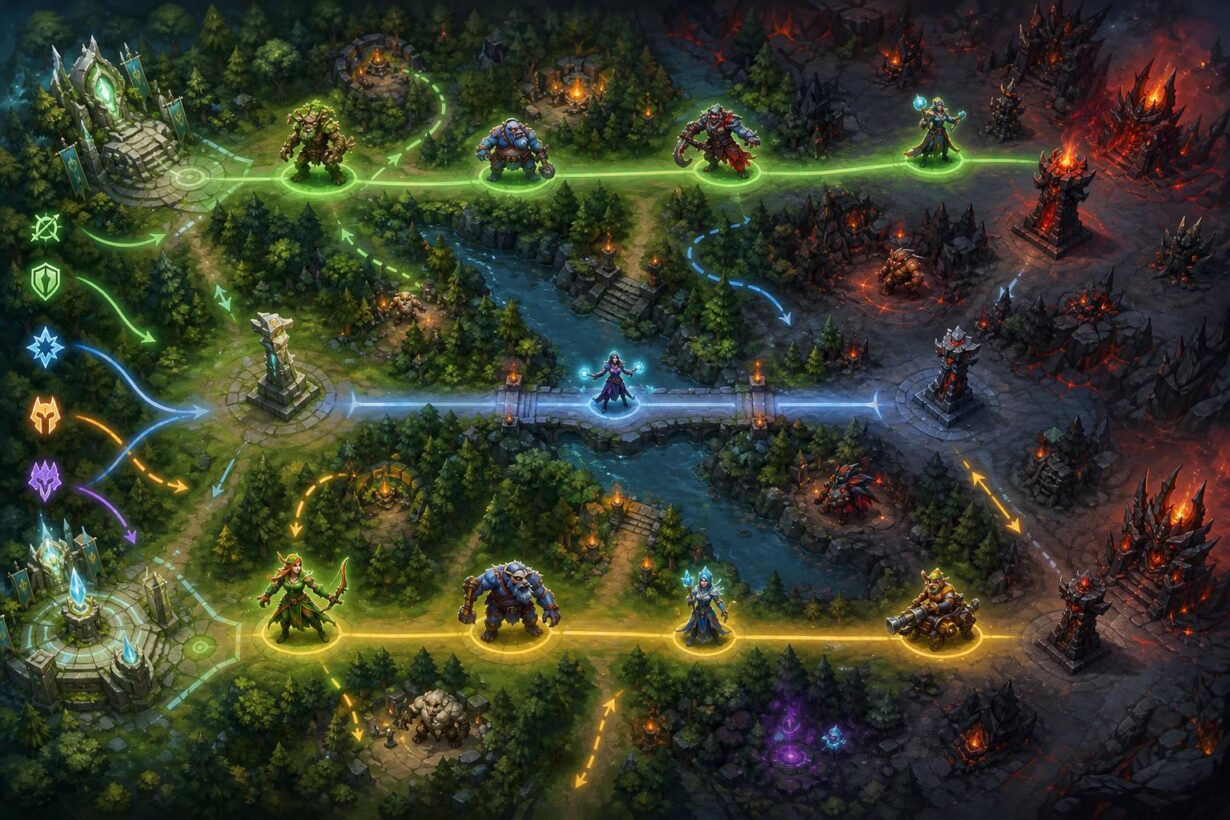

Dota 2 is a free-to-play MOBA (Multiplayer Online Battle Arena) that grew out of the original Defense of the Ancients mod. This Dota 2 beginner guide will walk you through the roles, lanes, and first heroes you need to know before jumping into a real match.
With more than 120 Dota 2 heroes, a sprawling map, and layers of strategy built on top of moment-to-moment combat, the game can feel overwhelming at first glance. The core concepts are more straightforward than they appear once someone breaks them down for you.
The fastest way to enjoy Dota 2 is to learn the win condition, pick an easy hero for your role, and focus on a few fundamentals at a time instead of trying to absorb everything at once. That approach is exactly what this guide delivers. You will learn how matches are won, what each lane and position expects from you, which heroes keep things simple, and what skills matter most during your first 20 games.
If you are already interested in the broader gaming-rewards space around titles like Dota 2, you can check out Rewardly to earn Coins through surveys, tasks, and referrals and redeem them for Dota 2 skins and gift cards at no markup.
Key Takeaways
- Every Dota 2 match is won by destroying the enemy Ancient, and every lane, role, and objective feeds into that single goal.
- Starting with low-complexity heroes like Crystal Maiden, Juggernaut, or Bristleback lets you learn game flow without fighting your own hero’s kit.
- Focusing on last-hitting, basic warding, and smart positioning during the laning phase will improve your results faster than memorizing item builds.
How a Dota 2 Match Is Won
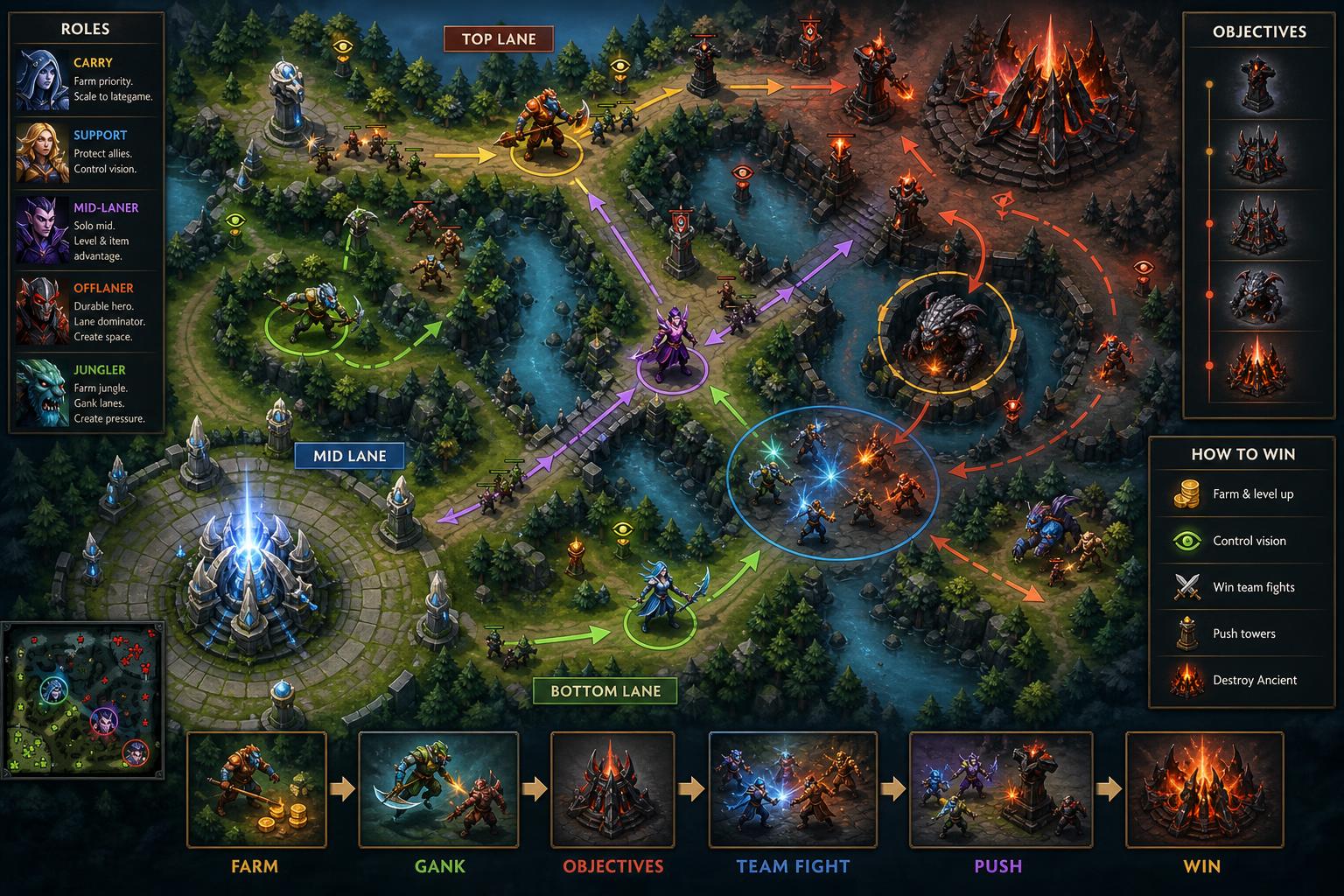
Two teams of five players, Radiant and Dire, fight across a symmetrical map with a single objective: destroy the enemy team’s Ancient. Every tower push, team fight, and farming pattern feeds into that goal. The structures, creeps, and map layout below are the building blocks you need to understand before your first real match.
The Ancient, Towers, and Barracks
The Ancient is the large structure at the heart of each base. It cannot be attacked until the two tier-four towers standing directly in front of it are destroyed.
Each of the three lanes is defended by a chain of towers (tier one through tier three). Towers deal significant damage to heroes and must be taken down sequentially from the outermost tier inward.
Behind each lane’s tier-three tower sit a melee barracks and a ranged barracks. When you destroy a lane’s barracks, your lane creeps in that lane become stronger.
Destroy all six barracks across all three lanes and your team spawns mega creeps. These are powerful enough to overwhelm most defenses on their own.
Radiant, Dire, and the Dota 2 Map
The Dota 2 map is split diagonally. Radiant occupies the bottom-left portion; Dire holds the top-right.
Three Dota 2 lanes connect the two bases: top, middle, and bottom. Between those lanes lies the jungle, filled with neutral camps on both sides.
The river runs through the center, dividing Radiant territory from Dire territory and hosting key objectives like Roshan’s pit.
Each side’s jungle is a mirror image, giving both teams roughly equal access to farm and map control opportunities.
Lane Creeps, Neutral Creeps, and Experience
Lane creeps spawn every 30 seconds from each base and march toward the enemy Ancient. Each wave contains melee creeps and ranged creeps. Killing enemy lane creeps is your primary source of gold and experience during the early game.
Neutral creeps live in jungle camps and respawn every minute if the camp is empty. They provide supplemental gold and experience, especially for cores who rotate into the jungle between lane waves.
Every unit you kill (or stand near when an ally kills it) grants experience, which levels up your hero and unlocks stronger abilities. Efficient farming of both lane creeps and neutral creeps is what separates a hero who peaks on time from one who falls behind.
Lanes, Positions, and Team Jobs
Dota 2 divides its five players into numbered positions (1 through 5) that dictate farm priority, lane assignment, and team responsibilities. Navigating the different Dota 2 lanes effectively requires knowledge of how each role interacts with the map.
The safe lane, middle lane, and hard lane each serve a distinct strategic purpose. The five Dota 2 roles slot into them based on what the team needs during the laning phase and beyond.
Safe Lane, Middle Lane, and Hard Lane
The safe lane is the lane closest to your own jungle. For Radiant that is the bottom lane; for Dire it is the top lane. It is called “safe” because the tower is positioned closer to your base, making it easier for the carry to farm without overextending.
The middle lane is the shortest lane on the Dota 2 map. It is a solo lane, meaning one hero from each team faces off one-on-one. Midlaners gain experience faster because they do not share it.
The hard lane (also called the offlane) is the lane farthest from your jungle. It is the most dangerous lane to farm in, which is why it is assigned to a durable hero who can survive pressure.
Dota 2 Positions From Carry to Hard Support
| Position | Common Name | Farm Priority | Typical Lane |
| 1 | Carry | Highest | Safe Lane |
| 2 | Midlaner | High | Middle Lane |
| 3 | Offlaner | Medium | Hard Lane |
| 4 | Soft Support / Roamer | Low | Hard Lane / Roaming |
| 5 | Hard Support | Lowest | Safe Lane |
The numbering system reflects gold priority. Position 1 gets the most farm; Position 5 gets the least. This does not mean supports are unimportant. Their impact comes from vision, crowd control, and enabling the cores to farm safely.
What Midlaner, Offlaner, and Roamer Actually Do
The midlaner (Position 2) wins or contests the middle lane, controls power-up runes, and rotates to side lanes for early ganks. Your job is to hit a power spike before other cores and translate that lead into map control.
The offlaner (Position 3) pressures the enemy safe lane carry, absorbs aggression, and transitions into a frontline initiator during team fights. Tankiness and initiation tools like Blink Dagger are your bread and butter.
The soft support / roamer (Position 4) starts in the hard lane alongside the offlaner but moves around the map to set up kills, stack neutral camps, and create space. Late game, you shift toward utility items that help your team win fights.
First Heroes That Are Easy to Learn
Picking a low-complexity hero lets you focus on learning the game instead of wrestling with complicated ability combos. Below are reliable starter picks for the roles most accessible to beginners, plus a note on why variety matters more than you might think.
Best Starter Supports Like Crystal Maiden
Crystal Maiden is one of the most recommended hard support picks for new players. Her kit is intuitive: one single-target stun, one area slow, a passive that gives mana regeneration to the entire team, and a channeled ultimate. She teaches you to position carefully because she is slow and fragile.
Other beginner-friendly supports include:
- Lion (Hard Support / Soft Support): two disables, a mana drain, and a point-and-click ultimate that deletes a single target.
- Lich (Hard Support): a nuke that also denies a creep, a slow, and a bouncing ultimate that punishes enemies who clump together.
These heroes let you contribute to fights immediately while you learn warding, pulling, and positioning.
Simple Core Picks Like Juggernaut and Bristleback
Juggernaut is a safe lane carry with a forgiving kit. His Blade Fury makes him magic immune while dealing damage, his Healing Ward keeps him and allies alive, and his Omnislash ultimate is a point-and-click teamfight finisher. He farms efficiently with just basic last-hitting skills and stays relevant from the early game through the late game.
Bristleback is a tanky offlaner whose passive reduces damage taken from behind. You can focus on positioning and trading hits rather than memorizing complex combos. His Quill Spray stacks damage automatically, rewarding sustained fights.
For midlane, consider Viper or Zeus. Both have straightforward damage abilities and let you practice laning mechanics without worrying about flashy combos.
Why Trying Different Heroes Helps You Improve
Playing the same hero repeatedly builds comfort, but rotating through a handful of different heroes teaches you what each role actually does. When you play a hard support, you learn what your carry needs. When you play an offlaner, you understand why the enemy support is pulling creeps.
A good approach is to pick three to five heroes across two roles and alternate between them. You will develop broader game sense faster than someone who locks in a single hero every game.
Core Mechanics New Players Should Learn Early
Mechanics separate players who contribute from players who merely survive. Last-hitting, warding, and objective knowledge are the three skill areas that will produce the biggest improvement in your first weeks.
Last Hitting, Denying, and Farming Patterns
Last-hitting means landing the killing blow on an enemy creep to collect its gold bounty. Missing last hits delays your items and weakens your mid-game timing. Practice in demo mode or bot matches until you can consistently secure four out of every five creeps in a wave.
Denying is the flip side. You can attack your own creeps once they drop below 50% health. A successful deny reduces the gold and experience your opponent receives. In the laning phase, even a few denies per minute create a meaningful gap.
Basic farming patterns matter, too. As a core, alternate between clearing your lane wave and farming the nearest jungle camp. This “push wave, take camp” rhythm maximizes your gold per minute without leaving the lane unattended for too long.
Warding With Observer Wards and Sentry Wards
An observer ward provides a large area of vision for six minutes. Placing them near rune spots, jungle entrances, and Roshan’s pit keeps your team informed about enemy movements. Vision wins games.
A sentry ward reveals invisible units and enemy wards within a smaller radius. Use them to de-ward enemy observer wards or detect heroes with invisibility abilities.
Warding is traditionally the support’s job, but every player benefits from understanding where wards should go. If you are a core and notice your map is dark, buy a ward yourself. It costs almost nothing and can save your life.
Runes, Outposts, and Roshan Rewards
Power-up runes spawn in the river at set intervals and grant temporary buffs like double damage, haste, or invisibility. Midlaners typically contest these, but any hero can grab one.
Outposts are capturable structures located in each team’s jungle. Controlling them grants bonus experience to your team at regular intervals and provides a teleport destination, extending your map control.
Roshan is the toughest neutral creep on the map. Killing him awards the Aegis of the Immortal (a free resurrection), and subsequent kills can drop Cheese (instant health and mana restore) and a Refresher Shard (resets all ability cooldowns once). Taking Roshan is often the turning point that sets up a base push. Coordinate with your team before attempting it, and make sure you have vision of the enemy so you are not ambushed.
What to Focus on in Your First 20 Games
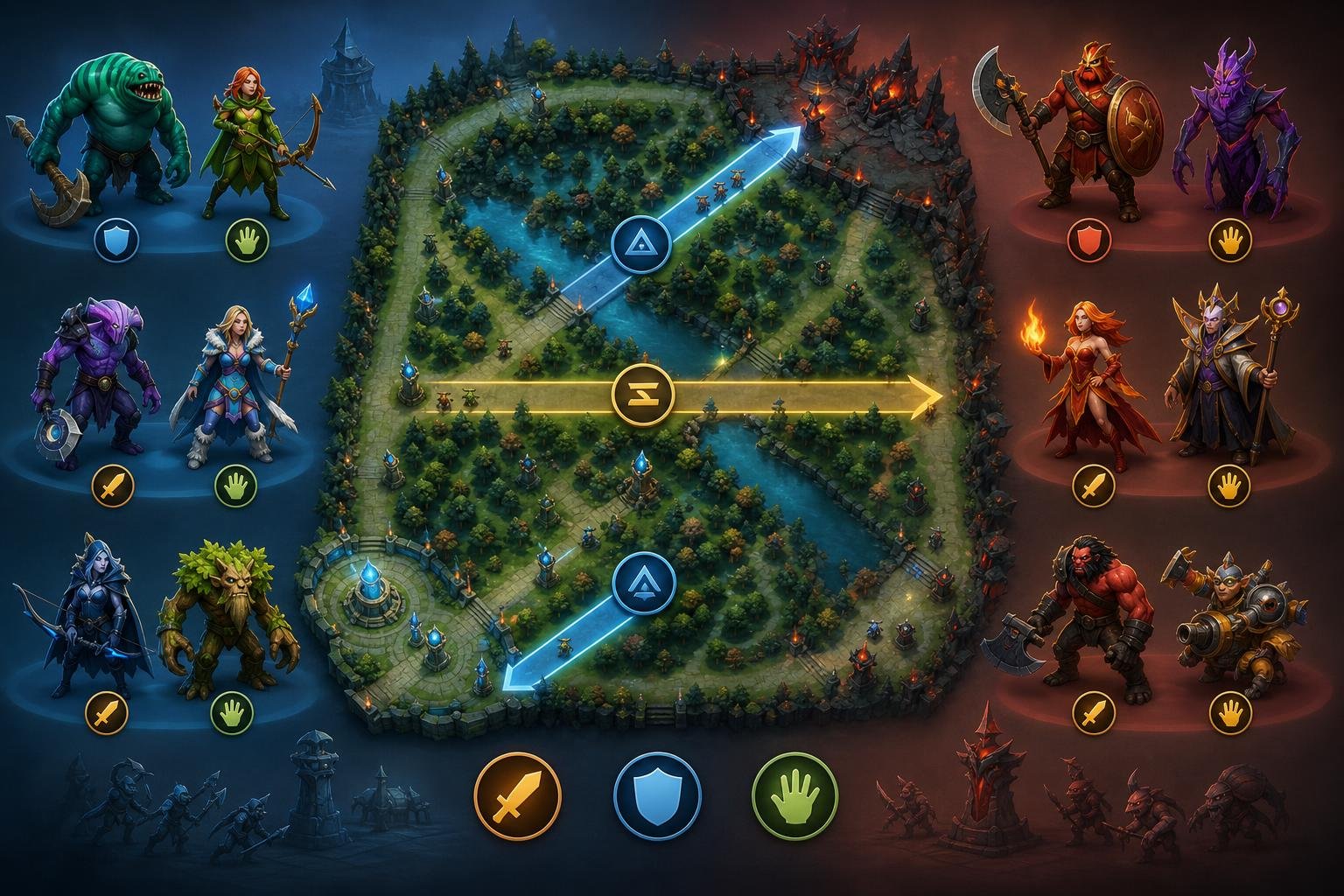
Your first 20 games are not about winning every match. They are about building habits that compound over hundreds of games. Prioritize the laning phase, learn when to move across the map, and identify the mistakes that cost you the most so you can fix them early.
Good Habits During the Laning Phase
Focus on creep equilibrium. If the creep wave pushes too far toward the enemy tower, you become vulnerable to ganks. If it sits near your tower, you farm more safely. Pull, aggro, and deny creeps to keep the wave where you want it.
Buy your starting items before the horn sounds. Supports should grab observer wards and a sentry ward, plus regeneration. Cores need stat items and tangos.
Communicate your lane. A simple ping on the minimap to signal a missing enemy hero can prevent a teammate’s death.
When to Rotate, Gank, or Defend
Rotations happen when you leave your lane to influence another part of the map. As a soft support or roamer, look for gank opportunities once you hit level three or four and have at least one reliable disable.
As a midlaner, rotate after securing a power-up rune or hitting a strong level spike (usually level six). Look for a side lane where your teammate has crowd control and the enemy is pushed forward.
Defend your towers when creeps are hitting them and no ally is nearby, even if it means temporarily leaving your jungle farm. Losing a tier-one tower early gives the enemy team dangerous map control.
Common Beginner Mistakes and How to Avoid Them
Dying without buyback in the late game. Keep enough gold reserved for buyback once you pass the 30-minute mark. A single death without buyback can lose the entire match.
Ignoring the minimap. Glance at it every few seconds. If you see three enemy heroes missing, play defensively.
Buying items on autopilot. Guides are helpful, but adapt. If the enemy has heavy magic damage, build magic resistance even if your guide says otherwise.
Fighting without a purpose. Every fight should have an objective behind it: take a tower, secure Roshan, or defend barracks. If there is no objective, farm instead.
Platforms like Rewardly let you earn rewards for gaming-related items including Rust skins and Dota 2 items, so the hours you spend learning the game can also feed into building your cosmetic collection over time.
Frequently Asked Questions
What do positions 1 through 5 mean in Dota 2?
Positions 1 through 5 represent farm priority. Position 1 (the carry) gets the most gold, and Position 5 (the hard support) gets the least. The system helps teams distribute resources efficiently so each player knows who should be farming and who should be creating space.
Which lanes do each role typically play, and what are their main responsibilities?
The carry (Position 1) plays the safe lane and focuses on farming. The midlaner (Position 2) goes middle lane for solo experience. The offlaner (Position 3) takes the hard lane and disrupts the enemy carry. The soft support (Position 4) starts in the hard lane but roams for ganks. The hard support (Position 5) babysits the carry in the safe lane and handles warding.
What is the easiest role to start with as a new Dota 2 player?
Hard support (Position 5) is widely considered the easiest starting role. You do not need to worry about last-hitting perfectly or managing complex farming patterns. Your main responsibilities are placing wards, keeping your carry alive, and using your spells in fights.
Which beginner-friendly heroes are recommended for each role?
For hard support, try Crystal Maiden or Lich. For soft support, Lion works well. Bristleback and Centaur Warrunner are strong beginner offlaners. Juggernaut and Sniper are solid carries. Viper and Zeus are approachable midlaners. All of these heroes have low-complexity kits that let you focus on game fundamentals.
How do I choose the right lane and role in a match based on my team’s draft?
Check what your team already has during the picking phase. If your team lacks a frontline hero, consider offlane. If no one has selected support, fill that gap. Avoid picking a second carry if your team already has one. Communication during the draft, even through pings and chat wheel, prevents overlapping roles.
What are good Position 3 (offlane) heroes for beginners, and why?
Bristleback, Centaur Warrunner, and Tidehunter are excellent choices. Bristleback passively reduces damage from behind, letting you survive mistakes. Centaur has a straightforward stun-and-nuke combo. Tidehunter’s Ravage ultimate is a massive area stun that is nearly impossible to misuse. All three heroes are naturally tanky, which gives you a larger margin for error while you learn.