
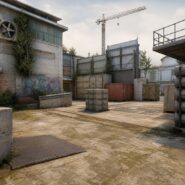
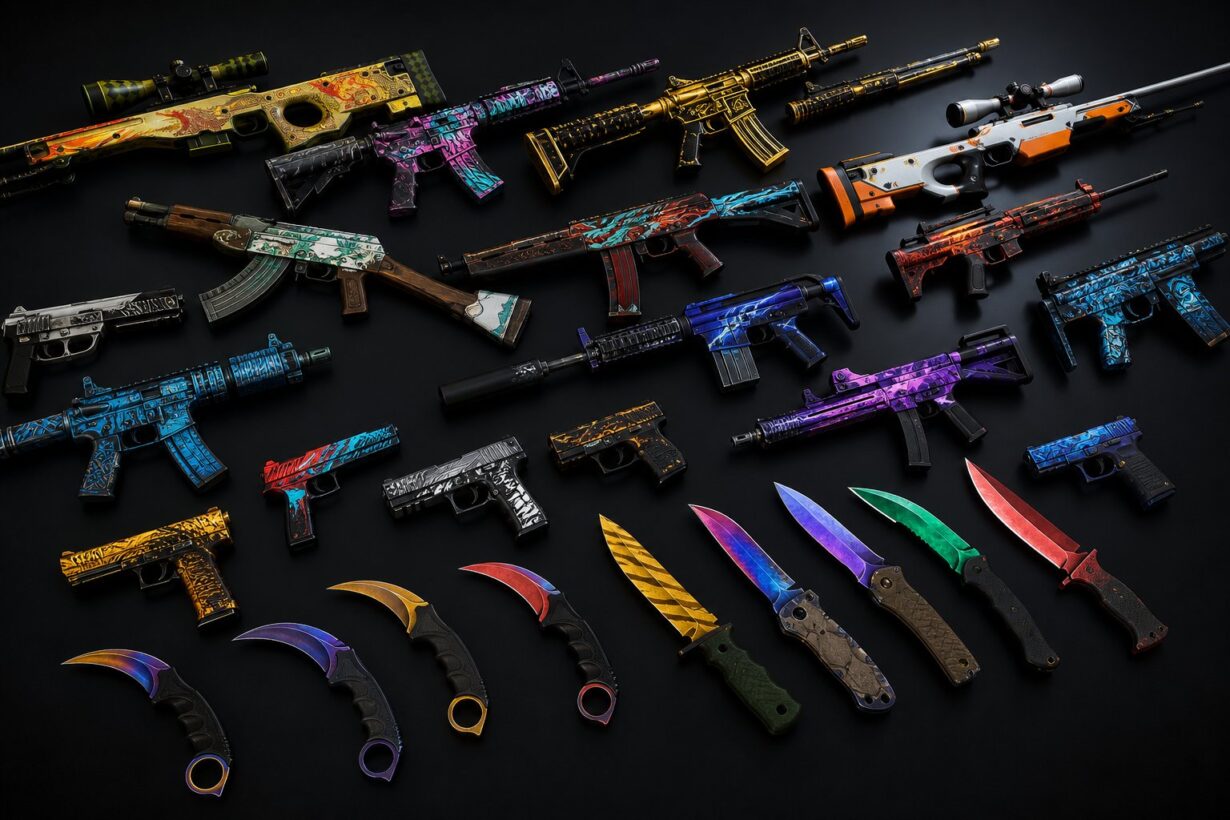

Every Counter-Strike player remembers the first time a rare skin stopped them mid-round. Maybe it was a teammate’s AWP Dragon Lore gleaming under Dust II sunlight, or an enemy’s Karambit Fade spinning in the kill feed. Those moments stick because the most iconic CS2 skins aren’t just pixels. Choosing the best CS2 skins for your collection is a rite of passage. They are status symbols, community folklore, and miniature works of art wrapped into a single inventory slot.
The skins that define a dream inventory have earned their reputation through a mix of scarcity, visual impact, esports history, and the stories players tell about them. That reputation extends beyond Counter-Strike, too. Dota 2 Arcanas, the Burning Team Captain in TF2, and limited Rust skins all occupy the same emotional space: items people chase not because they need them, but because owning one says something about who they are in a game’s culture.
This piece traces the cosmetics that became legends across CS2, Dota 2, TF2, and Rust. You’ll find origin stories, rough current values, and a realistic look at how players work toward these grails, whether through trading, patience, or reward platforms that let you earn toward gift cards and skins without spending your own cash.
What Makes A Cosmetic Truly Iconic
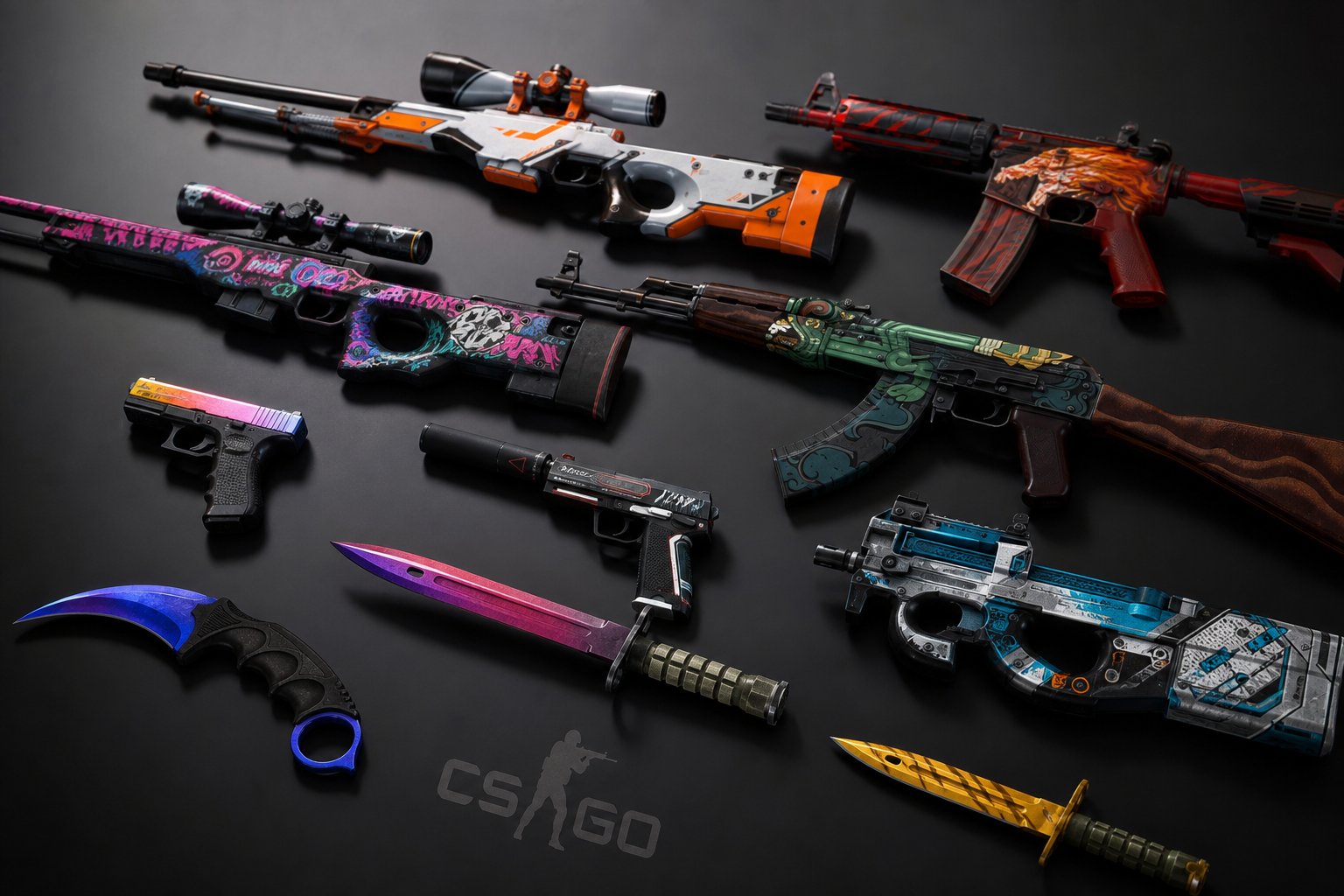
Iconic skins don’t earn that label overnight. They survive shifting metas, new case releases, and years of community debate. Popular CS2 skins often start as niche favorites before exploding in value due to pro usage.
The ones that stick share a few core ingredients: they’re hard to get, impossible to ignore in-game, and wrapped in a story players actually want to retell. Building a dream inventory means chasing items that check all of those boxes at once.
Rarity, Visibility, And Status
Scarcity is the foundation. A skin released in a discontinued case or capped by a contraband tag can never be diluted by fresh supply. The M4A4 Howl is the clearest example: Valve removed it from active drops, stamped it “Contraband,” and its fiery wolf illustration became one of the most dramatic skin events in Counter-Strike history. No new copies will ever exist.
Visibility matters almost as much. A gorgeous pistol grip that only the owner sees during reloads rarely reaches icon status. Rifles, AWPs, and knives dominate the spotlight because every spectator, streamer, and tournament camera catches them. The bright orange panels of the AWP Asiimov practically glow on Twitch thumbnails.
Status ties rarity and visibility together. When a lobby loads and you spot a Factory New Karambit Doppler or a Desert Eagle Blaze, you instantly know the owner invested serious effort. That silent flex is exactly what turns a cosmetic into a cultural marker. A full-fade Glock-18 or a rare knife finish signals status in every match.
Lore, Esports, And Community Memory
Design alone doesn’t create an icon. The backstory does. The AK-47 Case Hardened “Blue Gem” didn’t come from Valve’s marketing department; the concept was born entirely from community fascination with pattern indexes that produce near-full blue surfaces. Collectors turned a random procedural output into a grail worth six figures.
Esports amplifies everything. When a pro clutches a 1v4 on a Major stage holding a Dragon Lore, that skin is permanently fused to the highlight reel. As noted in an analysis of skins used by pro players, Dragon Lore still commands roughly 15.6 percent usage among top-tier competitors, a stat that feeds its mystique year after year.
Community memory is the final ingredient. Players pass down opinions on forums, Reddit threads, and trade servers. When enough voices call an item a “classic,” a collective consensus forms that newcomers adopt without question. The skin’s name becomes shorthand for prestige, and that status is nearly impossible to reverse.
The CS2 Skins That Defined Flex Culture
Flex culture in Counter-Strike runs deeper than most gaming communities realize. The Dragon Lore, Fire Serpent, and a rotating cast of knives and gloves shaped a social hierarchy where your loadout communicates as loudly as your aim. These are the items that set the template for what a dream inventory looks like.
AWP Dragon Lore And The Myth Of The Grail Skin
No skin in gaming history carries more weight than the AWP Dragon Lore. Its hand-painted medieval dragon and gold tapestry pattern debuted in the Cobblestone Collection, available only as souvenir drops during specific Major tournaments. That distribution method meant supply was razor-thin from day one.
Prices reflect the mythology. Factory New non-souvenir Dragon Lores regularly trade above $10,000, and souvenir versions signed by Major MVPs have exceeded $1 million in confirmed sales. The skin’s value isn’t purely financial, though. It’s cultural. Watching s1mple or ZywOo scope in with a Dragon Lore during a Grand Final feels like witnessing a relic in action.
What makes the Dragon Lore a true grail is that its prestige has never faded. New skins come and go, but the Dragon Lore remains the benchmark every flashy AWP gets measured against. If you’ve ever set a long-term skin goal, odds are this one crossed your mind first.
AK-47 Fire Serpent And Early Covert Prestige
The AK-47 Fire Serpent arrived in 2013’s Operation Bravo Case, making it one of the oldest covert skins still actively traded. Its tribal serpent rising through flames draws on ancient Mesoamerican imagery tied to gods of fire and war, giving the design a weight that purely sci-fi or abstract skins rarely achieve.
Picking up a Fire Serpent today costs roughly $800 to $2,500 depending on wear, with Factory New copies sitting at the premium end. What keeps demand high is the combination of age, discontinued source case, and visual punch. The warm orange and green tones pop on Source 2 lighting in a way that newer AK skins struggle to match.
For many collectors, the Fire Serpent represents the bridge between CS’s early experimental skin economy and the mature market we know today. Owning one says you appreciate where the skin ecosystem started, not just where it is now.
Knives, Gloves, And The Rise Of Inventory Identity
Knives were the original flex. Pulling a Karambit, Butterfly, or M9 Bayonet during a round-end inspection became a ritual, and the community quickly assigned tier lists to each knife type and finish. Fade, Doppler, and Crimson Web finishes dominated wish lists, while rare pattern phases like Sapphire, Ruby, and Emerald on Doppler knives pushed prices into five-figure territory.
Gloves changed the game again when Valve added them in 2016. Suddenly every first-person frame featured your chosen cosmetic. Sport Gloves in Pandora’s Box or Specialist Gloves in Crimson Kimono became the new markers of a fully curated loadout. Items like the Desert Eagle Blaze also grew in fame because they look incredible in Source 2 lighting. This pistol remains a staple of high-tier inventories due to its historical rarity.
Here’s a snapshot of iconic knife and glove picks along with approximate 2026 market ranges:
| Item | Finish / Pattern | Approx. Price Range (USD) |
| Karambit | Doppler Sapphire (FN) | $8,000 – $12,000 |
| Butterfly Knife | Fade (FN, full fade) | $3,500 – $5,000 |
| M9 Bayonet | Crimson Web (MW) | $4,000 – $7,000 |
| Sport Gloves | Pandora’s Box (MW) | $6,000 – $9,000 |
| Specialist Gloves | Crimson Kimono (FT) | $2,000 – $4,000 |
Values fluctuate with Steam Community Market and third-party platform activity. Verify against live listings before making decisions.
The takeaway: knives and gloves turned inventories into curated galleries. Matching a knife finish to your glove tint became its own subculture, and for many players, nailing that combo matters more than any single rifle skin.
Legendary Cosmetics Beyond Counter-Strike
CS2 may dominate the skin conversation, but Dota 2, TF2, and Rust each built their own ecosystems of prestige cosmetics. The emotional pull is the same: scarcity, community storytelling, and a visual identity that separates your account from everyone else’s. A true dream inventory spans games, not just weapon slots.
Dota 2 Arcanas As Prestige Cosmetics
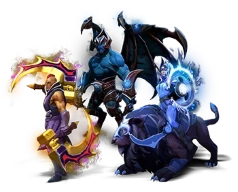
Arcana items sit at the top of Dota 2’s cosmetic hierarchy. They overhaul a hero’s model, animations, voice lines, and ambient effects. Early Arcanas like the Lina Fiery Soul of the Slayer and the Terrorblade Fractal Horns of Inner Abysm set the standard, but it’s the Pudge Feast of Abscession and the Phantom Assassin Manifold Paradox that became true collector benchmarks.
The community-voted Arcanas carry extra prestige. When millions of players chose Ogre Magi or Wraith King to receive an Arcana through The International’s Battle Pass, those items became time-limited badges of participation. Newer Arcanas released exclusively through seasonal Battle Passes can never be obtained again, which has pushed their aftermarket value steadily upward.
| Arcana | Hero | Approx. Market Price (USD) |
| Demon Eater | Shadow Fiend | $25 – $35 |
| Manifold Paradox | Phantom Assassin | $30 – $45 |
| Feast of Abscession | Pudge | $25 – $40 |
| Great Confluence (BP Exclusive) | Void Spirit | $80 – $150+ |
| Bladeform Legacy | Juggernaut | $25 – $35 |
Battle Pass-exclusive Arcanas command premiums because supply is permanently locked.
For Dota 2 players, equipping an Arcana is the equivalent of pulling out a Karambit Fade in CS2. It signals commitment to a hero and to the game itself.
TF2 Hats And The Legacy Of Burning Team Captain
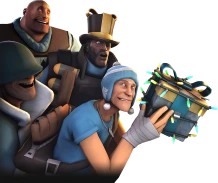
Team Fortress 2 practically invented the modern cosmetic economy. Hats became the currency of identity years before CS skins existed. Among the thousands of cosmetics, the Burning Team Captain stands alone as the game’s most storied item.
The Team Captain is a military officer’s cap inspired by M. Bison from Street Fighter. When paired with the “Burning Flames” unusual effect, it becomes the Burning Team Captain, an item so rare and culturally significant that confirmed sales have exceeded $10,000. Only a handful exist across all TF2 inventories.
Other unusual effects like Scorching Flames, Sunbeams, and Harvest Moon created their own micro-markets. TF2’s unusual hat economy pioneered the concept of effect-driven rarity tiers, something CS2 later echoed with knife phases and glove patterns.
If you played TF2 during its golden era, you remember the reverence a server gave to someone wearing a Burning Team Captain. That emotional imprint is exactly what makes an item legendary.
Rust Skins That Became Collector Favorites
Rust takes a different approach to cosmetic scarcity. Many skins are sold through the Rust Item Store on a weekly rotation and are never re-released. This “buy it now or miss it forever” model creates artificial scarcity that drives collector behavior.
Some standout collector items include:
- Tempered AK47 – One of the most sought-after rifle skins, featuring a dark metallic finish with orange accents. Aftermarket prices can top $200.
- Glory AK47 – A military-themed skin with patriotic styling that rarely appears below $150.
- Alien Red Hoodie – An early character cosmetic that became a meme and a flex simultaneously.
- Dragon Door – A deployable base cosmetic that functions as both art and a statement piece for your compound.
Rust’s skin economy feels more grassroots than CS2’s. There are no cases to open; you either bought the skin during its store window or you trade for it later at a premium. That simplicity gives long-time Rust players a quiet pride in their collections that mirrors the nostalgia CS2 veterans feel about early Operation skins.
Why Certain Items Keep Their Dream Status
Some skins spike in value for a month and then quietly fade. Others hold their dream inventory status for years, even decades. The difference comes down to a specific combination of supply mechanics, cultural momentum, and social reinforcement that ordinary cosmetics never achieve.
Scarcity, Age, And Market Storytelling
Every iconic skin benefits from a supply ceiling. Discontinued cases, removed drop pools, and one-time event distributions all create hard limits. As an analysis of rare CS2 skin appreciation points out, skins tied to cases that no longer drop gain value over time simply because copies leave circulation through trade bans, abandoned accounts, and accidental trade-ups.
Age compounds that scarcity. A skin from 2013 carries a historical weight that a 2025 release can’t fake. The AK-47 Fire Serpent, the Glock-18 Fade, and the original Crimson Web knife finishes all benefit from a decade-plus pedigree. Collectors treat them like vintage sneakers: the older and cleaner the condition, the more desirable.
Market storytelling wraps it all together. When a Case Hardened pattern #661 sells for $1.5 million and the transaction makes headlines, it reinforces the narrative that CS2 skins are real assets. That narrative attracts new collectors, which increases demand against a fixed supply. The cycle feeds itself.
Streamers, Tournament Moments, And Social Proof
Streamers act as tastemakers. When a popular creator unboxes a knife on camera and the clip goes viral, thousands of viewers add that exact item to their personal wish list. The social proof is instant and powerful.
Tournament moments are even stickier. If you watched a legendary AWP ace with a Dragon Lore during a Major semifinal, that memory is permanently linked to the skin. Certain skins remind fans of specific tournaments, famous players, or dramatic rounds that shaped Counter-Strike history.
The community then codifies these moments. Reddit threads, YouTube retrospectives, and Twitter highlight clips keep the stories circulating. Over time, a consensus forms that becomes nearly impossible for newcomers to challenge. The skin’s status solidifies into something closer to folklore than marketing.
From Admiring To Earning Toward Top-Tier Items
Wanting a Dragon Lore and actually working toward one are very different things. The gap between “dream inventory” and “realistic next purchase” is where most collectors get stuck. Closing that gap requires a clear value target and a willingness to stack small wins over time.
Setting Realistic Value Targets
Start by auditing what you actually use in-game. If you main the AK-47 and AWP, a $15 Redline and a $30 Asiimov in Battle-Scarred give you two iconic skins for under $50. That’s a far better starting point than fixating on a $10,000 grail you may never afford.
Break your dream inventory into tiers:
| Tier | Budget Range (USD) | Example Items |
| Starter flex | $5 – $25 | AK-47 Redline (FT), USP-S Cortex, Glock-18 Water Elemental |
| Mid-tier staples | $25 – $150 | AWP Asiimov (BS/WW), M4A1-S Printstream (FT), AK-47 Bloodsport, Deagle Kumicho Dragon |
| Aspirational pieces | $150 – $1,000 | AK-47 Fire Serpent (BS), Butterfly Knife Vanilla |
| Grail territory | $1,000+ | AWP Dragon Lore, Karambit Doppler Sapphire |
Knowing which tier you’re realistically targeting prevents impulsive trades. The AK-47 Bloodsport is a fantastic example of a skin that looks premium without the extreme cost of a Fire Serpent. Stacking your progress methodically makes the best CS2 skins feel attainable over time.
Using Rewards And Gift Cards To Work Toward Cosmetics
You don’t have to spend your paycheck to build momentum. Reward platforms let you convert free actions into tangible value. On Rewardly, for instance, you can earn Coins by completing surveys, offerwall tasks, watching videos, and referring friends, then redeem those Coins for Steam gift cards at face value with no markup. The exchange rate sits at a flat 1,000 Coins per $1, and the minimum redemption is just $5.
That $5 Steam card can fund a decent starter skin or get stacked over a few weeks into something more substantial. The key is consistency: daily streaks and quests compound, and referral commissions between 3 and 8 percent add passive earning on top.
Whether you use reward platforms, careful trading, or a mix of both, the principle is the same. Treat your dream inventory as a project, not a lottery ticket, and the iconic skins you’ve been admiring become items you can actually own.
If you’re ready to start earning toward CS2, Dota 2, TF2, or Rust skins, Rewardly offers a straightforward path to get there.
Frequently Asked Questions
Which weapon skins are considered the most legendary across Counter-Strike history?
The AWP Dragon Lore, M4A4 Howl, AK-47 Fire Serpent, AK-47 Case Hardened (Blue Gem patterns), and the Glock-18 Fade consistently top every community ranking. These skins earned their legendary status through a combination of discontinued supply, distinctive artwork, and deep ties to esports history and community lore.
What are the top skin picks for each weapon in CS2 right now?
Popular choices shift with new case releases, but strong picks in 2026 include the AK-47 Bloodsport or Fire Serpent, AWP Asiimov or Dragon Lore, M4A1-S Printstream, M4A4 Howl, USP-S Kill Confirmed, and Glock-18 Fade. The Desert Eagle Blaze and the Kumicho Dragon are also among the most popular CS2 skins for pistol rounds. According to pro player usage data, these skins dominate competitive loadouts as well.
Which CS2 skins are the most expensive and why do they cost so much?
The most expensive CS2 skins include souvenir AWP Dragon Lores, AK-47 Case Hardened Blue Gem (pattern #661), and specific Karambit Doppler Sapphires. Verified sales have exceeded $1 million for the rarest items. Prices are driven by extreme scarcity, discontinued source cases, desirable float values, and the cultural prestige attached to owning a piece of Counter-Strike history.
What is the most expensive AK-47 skin in CS2?
The AK-47 Case Hardened with a pattern index of #661, known as the “Blue Gem,” holds the record as the most expensive AK-47 skin. StatTrak Factory New versions of this pattern have sold for hundreds of thousands of dollars. The AK-47 Fire Serpent in Factory New with low float also commands prices in the $2,000 to $3,000+ range, though it sits well below the Blue Gem’s peak.
How does skin wear (Factory New, Minimal Wear, etc.) affect looks and value in CS2?
CS2 uses five wear grades: Factory New, Minimal Wear, Field-Tested, Well-Worn, and Battle-Scarred. Each grade corresponds to a float value range that determines how scratched or faded the skin appears. Factory New items with the lowest float values carry the highest premiums because they display the cleanest version of the artwork. For some skins like the AWP Asiimov, Battle-Scarred versions are popular because they still look good at a fraction of the cost.
What are the best budget-friendly skins to buy for under $1?
Under $1, you can find solid options like the AK-47 Elite Build, M4A1-S Boreal Forest, P250 Muertos, Glock-18 Moonrise, and the MAC-10 Neon Rider (in lower wear grades). These skins offer clean designs and decent in-game visibility without any real financial commitment. They’re a smart starting point if you’re building out your first loadout.