

Your Competitive Skill Rating, or CSR, is the single number that defines where you stand in CS2‘s Premier mode. Unlike the old CS system where a badge told you almost nothing about your actual Elo, Premier puts a real figure on your screen after every match. That number rises when you win, drops when you lose, and determines which color tier you wear for the season. If you have been away from Counter-Strike or just started playing Premier, the system can feel opaque. Having the cs2 csr explained in detail helps clear up the confusion, especially with Season 4’s medal deadline landing on July 6, 2026.
Your CSR is not a mystery stat; it is a visible, match-by-match scoreboard of your skill progression, and knowing how it moves is the first step to climbing intentionally. This guide breaks down how the rating works, what the tier colors mean, how calibration shapes your early matches, and what you need to lock in your Season 4 Premier medal before the deadline. It also covers the practical side of climbing: what actually pushes your number up, what drags it down, and which habits protect your progress across a full season.
At Rewardly, the focus is on the CS2 ecosystem from a player’s perspective. The platform lets you earn CS2 skins at Steam Community Market value without spending real money, so the motivation to play and progress stays rooted in the game itself. This guide reflects that same gamer-first perspective: clear information, no hype, no ranking shortcuts.
Key Takeaways
How Premier Ranking Works In CS2
Premier mode uses a numeric Competitive Skill Rating rather than a badge icon, and the entire system is built around a single active duty map pool with a pick-ban phase before each match. Your CSR goes up or down based on match outcomes, with the size of the change influenced by the relative ratings of both teams.
What Competitive Skill Rating Measures
CSR is a numeric representation of your matchmaking skill in Premier mode. It starts at a baseline after calibration and shifts with every win or loss. The number reflects team-level results first. Individual performance factors into hidden MMR calculations, but the visible CSR change you see on the post-match screen is driven primarily by whether your team won or lost.
Think of it as an Elo-style system. Beating a higher-rated lobby gives you more points; losing to a lower-rated one costs more. The system is designed to converge on your true skill level over time, not after a handful of matches.
Why Premier Uses A Numeric Rating
Valve introduced the numeric rating to solve a problem CS never fixed: rank ambiguity. A single badge like “Distinguished Master Guardian” told you almost nothing about how close you were to the next tier or how far you had fallen. As CS2’s ranking guide on Blix notes, Premier uses a numeric Elo-based rating ranging from 1 to 38,000 or higher, paired with a global leaderboard.
The number gives you granular feedback. You can track session-to-session movement, see exactly how much a loss cost you, and set concrete numeric goals instead of grinding toward a vague promotion.
How Premier Differs From Classic Competitive Ranks
Classic Competitive mode still exists and still uses the 18 traditional cs2 ranks from Silver I to Supreme Master First Class and Global Elite. The critical difference: these are map-specific ranks. You earn a separate rank on Mirage, a separate rank on Inferno, and so on. Within the cs2 competitive environment, Premier, by contrast, gives you one rating across the entire active duty pool.
Premier also uses the MR12 format (first to 13 rounds) and includes a map veto phase, mirroring the professional circuit structure. As a mode comparison on CS2.ad explains, the veto process and active duty pool make Premier the most relevant practice environment for competitive play. Your Competitive ranks and your Premier CSR are completely independent; progress in one does not affect the other.
When Your Rating Becomes Visible
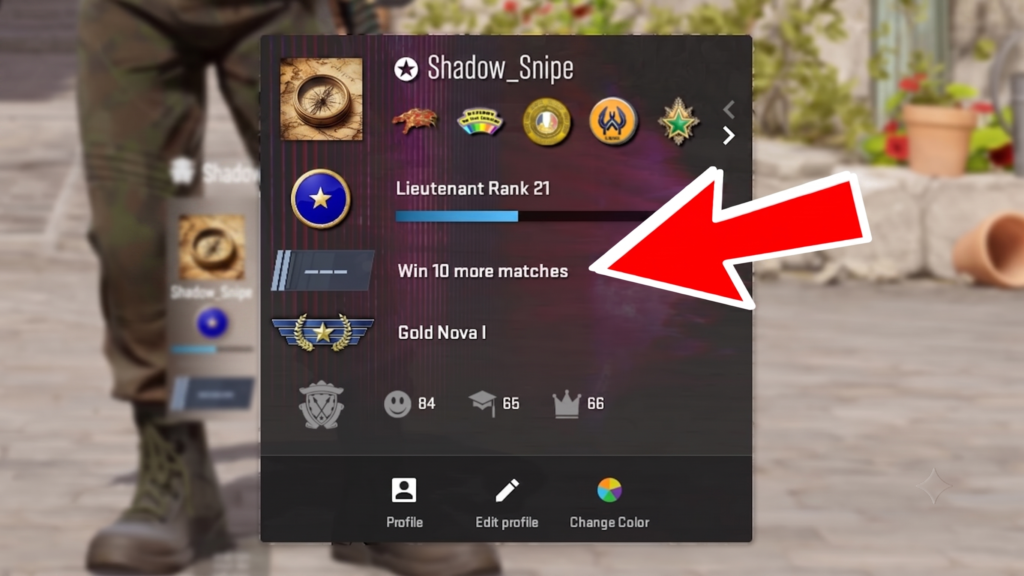
Before you see a CSR number on your profile, you need to complete a set of calibration matches. These placement games determine your starting rating, and the system treats them differently than regular ranked matches in terms of how much your rating can swing.
How Calibration Matches Work
When you first queue into Premier, the system places you in calibration. You need to play through a set of matches (typically around 10, though Valve has adjusted this number across seasons) before a visible CSR appears on your profile. During calibration, the matchmaking system is casting a wider net, testing you against players across a broader range of skill levels to figure out where you belong.
Your wins, losses, and the quality of opponents you face during these games all feed into the initial rating calculation. The system tries to place you accurately rather than starting everyone at the same floor.
What New Accounts Should Expect
If you are on a fresh account or returning after a long break, expect calibration to feel volatile. The system has very little data on you, so it responds aggressively to results. You might face opponents who feel too easy in one match and too difficult the next.
New CS2 accounts also need to meet minimum eligibility requirements before accessing Premier. As the CS2Practice ranking guide explains, placement matches carry more weight than standard matches because the system is actively narrowing your skill estimate.
Why Early Match Results Can Swing Harder
During and immediately after calibration, each win or loss can move your CSR by a larger margin than you will see once the system settles. This is by design. The algorithm has low confidence in your rating when sample size is small, so it adjusts faster.
After 30 to 50 matches, the swings typically stabilize. You will still gain and lose meaningful amounts, but the wild jumps should flatten out. If your CSR seems to move unpredictably early on, that is normal. The system is working as intended.
Premier Rank Tiers And CSR Ranges

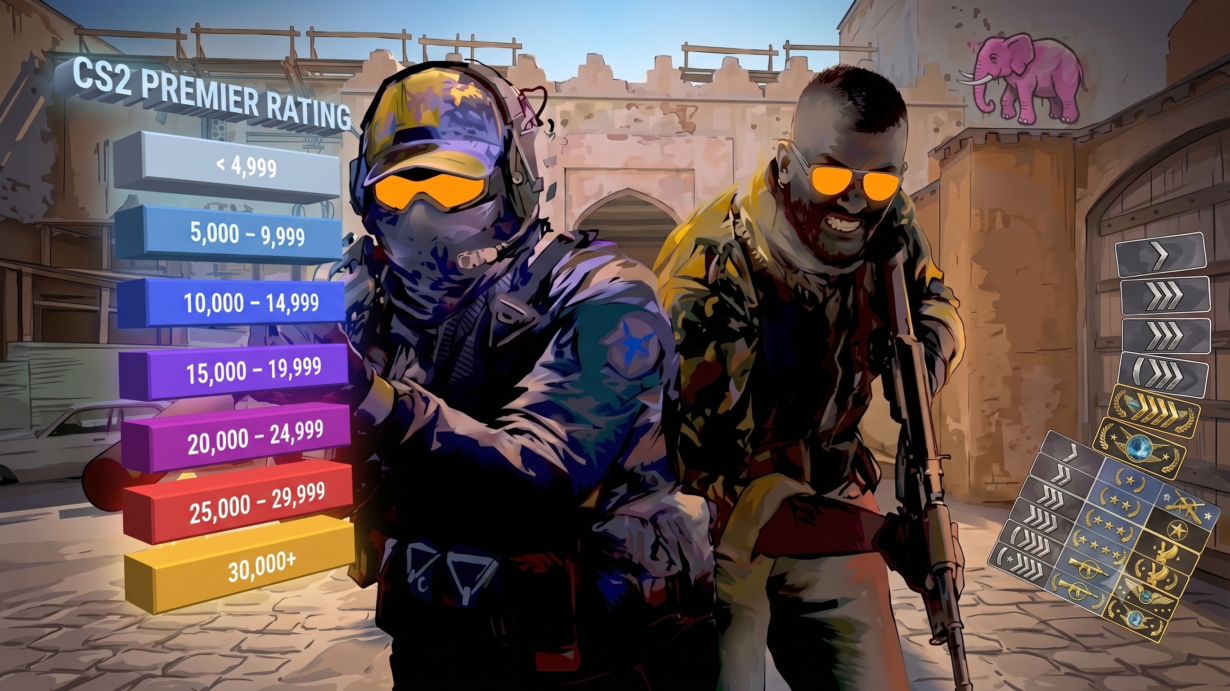
Premier organizes its numeric CSR into seven color-coded tiers. Each tier spans a 5,000-point range except for the top tier, which has no ceiling. Knowing where each tier starts helps you set realistic goals and avoid overreacting to small rating changes.
How The Color Tiers Are Structured
According to the Steam Community’s Premier rank guide, the cs2 premier ranks and premier rating tiers breakdown is:
Each tier boundary is a clean 5,000-point increment. Your tier color updates in real time as your CSR crosses these thresholds.
What Each Rating Band Usually Signals
Gray and Cyan cover the widest range of player experience, from genuinely new players to those still developing core mechanics. This area typically makes up the largest portion of the cs2 rank distribution. Sapphire and Amethyst represent the mid-tier, where most active players cluster. If you are in this range, you likely have solid fundamentals but inconsistencies in utility usage, positioning, or decision-making under pressure.
Rubellite and above signal strong competitive ability. Players at 20,000+ typically have refined aim, good map awareness, and consistent communication habits. Gold tier at 30,000+ is rare and represents the top percentile of the global leaderboard.
How To Read Tier Changes Without Overreacting
Crossing a tier boundary feels significant, but it is just a visual marker on a continuous scale. Dropping from 15,100 to 14,800 puts you back in Sapphire, but you are functionally the same player you were 300 points ago.
Focus on your rolling average over 20 to 30 matches rather than fixating on which color your profile shows right now. If your average is trending upward, you are climbing. A single bad session near a tier boundary does not erase real improvement.
What Makes CSR Go Up Or Down
Your Competitive Skill Rating changes after every Premier match, and the amount it moves depends on a few factors that are worth knowing clearly. Most frustration with the system comes from misreading what actually drives the number.
Win And Loss Impact From Match To Match
The most important variable is whether your team won. CSR is a win-loss system at its core. A win adds points; a loss subtracts them. The exact amount depends on the relative CSR of both teams.
If your team’s average rating is lower than your opponents’, a win rewards more points and a loss costs fewer. The reverse applies when you are the higher-rated side. This means not all wins are equal, and not all losses are equally punishing. As BoostRoom’s ranking breakdown notes, the visible CSR change is primarily match-outcome-driven.
Why Streaks Can Change Your Expected Gain
Win streaks and loss streaks affect CSR movement because the system adjusts its confidence in your current rating. A sustained win streak signals that you might be underrated, so the system starts giving larger gains per win to move you toward your true level faster.
The same logic works in reverse. As one Reddit discussion on CSR behavior highlights, players on loss streaks sometimes see larger losses per match, which can feel disproportionate. This is the system recalibrating. It is not punishment; it is the algorithm adjusting its estimate of where you belong.
Common Misreads About Personal Performance
A persistent myth is that your individual stats (kills, deaths, MVPs) directly control your visible CSR change. They do not, at least not in any confirmed, transparent way. Your individual performance may influence hidden MMR, which in turn affects the opponents you face, but the post-match CSR number is driven by the match result and the rating gap between teams.
Chasing stats to try to “protect” your CSR is counterproductive. Playing for the team win is always the optimal strategy for climbing. Drop 30 kills and lose, and you still lose rating. Go 15-18 but win a close game, and your CSR goes up.
Premier Seasons, Medals, And The Season 4 Deadline
CS2 Premier operates on a seasonal cycle, with each season lasting roughly six months. Your CSR carries forward with a soft reset between seasons, and your peak rating during the season determines the medal tier you earn.
How Seasonal Progress Is Tracked
Each season tracks your highest achieved CSR. At the end of the season, your peak rating maps to a medal tier. This means you do not need to finish at your peak; you just need to reach it at some point during the season. Seasons typically align with the Counter-Strike Major schedule, starting and ending around Major events.
Season 4 launched on January 19, 2026, and based on Esports Tales’ tracking of season end dates, it is expected to conclude in late June or early July 2026. The confirmed deadline for Season 4 is July 6, 2026.
What You Need To Earn The Premier Medal
Two requirements must be met before the season ends:
As Pley.gg’s Season 4 update confirms, you also need an account in good standing. If you have been inactive for an extended period and your CSR has decayed or become inactive, you may need to play additional matches before the deadline to reactivate it.
Your medal’s color corresponds to your peak CSR tier during the season. If you hit 20,500 at any point, you earn the Rubellite medal even if you finished the season at 18,000.
What To Check Before Season 5 Begins
Before Season 5 launches, verify a few things:
Expect a soft reset when Season 5 starts. Your CSR will likely compress toward the median, so early-season matches will again carry more weight as the system recalibrates.
Premier Versus Active Duty Map Ranks
CS2 runs two ranking systems in parallel: Premier’s numeric CSR and Competitive’s map-specific skill groups. They serve different purposes and appeal to different types of players.
Why The Two Systems Exist Side By Side
Premier gives you a single rating across the full active duty map pool, using the pick-ban format that mirrors professional play. Competitive lets you earn separate ranks on individual maps. Valve kept both because they measure different things.
Premier tests your ability to perform across the entire pool and adapt to your opponent’s map choice. Competitive lets you specialize. A player who only grinds Mirage might hold a Global Elite rank on that map while sitting at a modest Premier CSR because their Vertigo and Ancient play drags them down in the veto.
How Active Duty Affects Practice And Readiness
If you are serious about climbing Premier, Competitive mode functions as a low-risk training ground for your weaker maps. Playing a map you rarely veto in Competitive lets you develop familiarity with timings, callouts, and utility lineups without risking your Premier CSR.
As the Hone blog’s rank guide explains, your Competitive rank is tracked per map, so a bad loss on a new map does not touch your Premier number. Use that independence strategically. Grind your worst active duty map in Competitive until you feel confident enough to let it through in the Premier veto phase.
Which Rank Matters More For Different Goals
For most players focused on competitive progression and bragging rights, Premier CSR is the primary metric. It feeds into the global leaderboard and determines your seasonal medal. If you are looking to get scouted or prove yourself in a competitive setting, CS2.ad’s mode comparison notes that a high CS Rating carries more weight than a Competitive badge.
Competitive ranks still matter if you want to demonstrate map-specific mastery or if you prefer a less intense queue experience. Neither system is wrong. They just answer different questions about your skill.
How To Climb More Consistently
Climbing in Premier is less about secret techniques and more about removing the habits that cost you unnecessary rating points. The players who gain CSR steadily tend to be the ones who protect their rating during bad stretches, not just the ones who pop off during good ones.
Queue Habits That Protect Your Rating
Stop queuing after two consecutive losses. Your mental state deteriorates, your decision-making gets reactive, and the matchmaking system may start adjusting your expected gains downward during a losing streak. Take a break, review what went wrong, and come back fresh.
Queue at consistent times. Playing during your region’s peak hours gives the matchmaking system a larger pool to draw from, which means more balanced lobbies. Off-peak queues increase the odds of lopsided matches that can swing your CSR unpredictably.
If you play with a group, keep the rating spread tight. As Dignitas’s climbing guide notes, playing with higher-rated players increases the impact of each match result on your CSR.
Skill Areas That Translate Best To Premier Wins
Aim matters, but it is not the highest-leverage skill for climbing. The areas that correlate most strongly with consistent Premier wins are:
As the Steam Community climbing guide recommends, mastering two to three core maps rather than spreading yourself thin across the entire pool is one of the most effective ways to stabilize your win rate.
When To Stop Chasing Losses
There is a point in every session where continuing to queue stops being practice and becomes damage. If you have lost three or more in a row, the smartest play is to stop. Review your demos, practice utility in a private server, or switch to Competitive on a map you want to improve.
Chasing losses is the single most common way players lose hundreds of CSR points in a single sitting. Recognizing when you are tilted, even mildly, is a skill that directly protects your rating.
Why CSR Matters To The Broader CS2 Experience
Your CSR is more than a matchmaking number. It functions as a progress marker, a seasonal goal, and a reflection of how you are developing as a player across months of competitive play.
How Players Use Rank As A Progress Marker
For most players, CSR provides a concrete answer to the question, “Am I getting better?” Tracking your rating across a season shows trends that your memory alone cannot capture. A player who started Season 4 at 8,000 and sits at 13,000 in June has clear evidence of improvement, regardless of individual bad days.
Setting numeric CSR targets (reach Amethyst by mid-season, push for Rubellite by the deadline) gives your practice sessions direction. Without a visible number, competitive growth can feel abstract.
How Rewardly Fits Skin Motivation Without Affecting Rank
One of the reasons players grind Premier is to feel invested in the game, and having a loadout that reflects your commitment is part of that investment. Rewardly lets you earn CS2 skins at Steam Community Market value without depositing real money. You complete surveys, offerwall tasks, or refer friends to earn Coins, then redeem them for the skins you want.
This model keeps your skin motivation separate from your rank progression. Rewardly does not touch your CSR, your matchmaking, or your in-game performance. It simply gives you another way to build out your inventory while you focus on climbing. If you have been eyeing a specific skin to mark a rank milestone, you can earn CS2 skins on Rewardly’s CS2 page without spending out of pocket.
What To Track Across A Full Season
Beyond your raw CSR number, pay attention to these metrics across a season:
A season is long enough to smooth out variance. Trust the trend, not the individual data point.
Frequently Asked Questions
What does CSR mean in CS2 Premier mode?
CSR stands for Competitive Skill Rating. It is the numeric value assigned to your profile in Premier mode that represents your current skill level. The number updates after every match and determines your color tier, your position on the global leaderboard, and your seasonal medal eligibility.
How is your CS2 Premier rating calculated after each match?
Your CSR changes based on the match outcome and the relative ratings of both teams. Beating a team with a higher average CSR than yours awards more points, while losing to a lower-rated team costs more. As CSMarket’s rating system guide details, the system uses performance metrics alongside match results to inform hidden MMR, but the visible CSR shift is primarily win-loss driven.
Why is my CSR not visible or not updating in CS2?
Your CSR will not display until you complete your calibration matches. If you have already calibrated but your rating seems frozen, check whether you have been inactive long enough for your rating to become dormant. Playing a few matches should reactivate it. Ensure your account is in good standing and that you are queuing Premier, not Competitive.
What is the equivalent Competitive rank for a given Premier rating?
There is no exact one-to-one conversion. Premier CSR and Competitive skill groups are independent systems. As a rough reference from community mapping guides, a CSR around 10,000 to 15,000 loosely correlates with the Gold Nova to Master Guardian range, but these comparisons are approximate and vary by region and season.
What are the main differences between CS2 Premier and Competitive ranking systems?
Premier uses a single numeric rating across the entire active duty map pool with a pick-ban phase before each match. Competitive assigns a separate traditional rank (Silver I through Global Elite) for each individual map. Premier mirrors professional match structure, while Competitive allows map-specific specialization. The two systems do not affect each other, as Dot Esports’ rank explainer covers.
What is the maximum Premier rating difference allowed to queue together in a party?
Valve limits the CSR gap between party members to prevent highly mismatched lobbies. The current threshold is approximately 5,000 CSR points between the highest and lowest rated players in a premade group. If your party exceeds this gap, the game will block you from queuing into Premier together. Check the CS2 client for the most current restriction, as Valve occasionally adjusts this limit between seasons.