


The cs2 dead hand terminal changed how CS2 players acquire skins when it launched in March 2026. Instead of paying for a key and receiving one random item, you open the terminal for free, review up to five randomized skin offers, and decide whether to buy any of them. That single twist, the ability to pass on an offer, reshapes every value calculation you would normally make with a traditional case.
The Dead Hand Terminal is the first terminal in CS2 to include gold-rarity items (gloves), which makes it both the most exciting and the most misunderstood container in the current drop pool. It contains 17 community-designed weapon skins and 22 new glove finishes, all distributed through a selection mechanic that replaces luck-of-the-draw with a series of buy-or-skip decisions.
This guide breaks down exactly how the terminal format works, what sits inside the Dead Hand drop pool, how the odds translate into realistic expected value, and whether you should open, pass, or sell. If you care about making informed decisions with your weekly drops rather than gambling blind, this is the breakdown you need.
How Terminal Drops Work
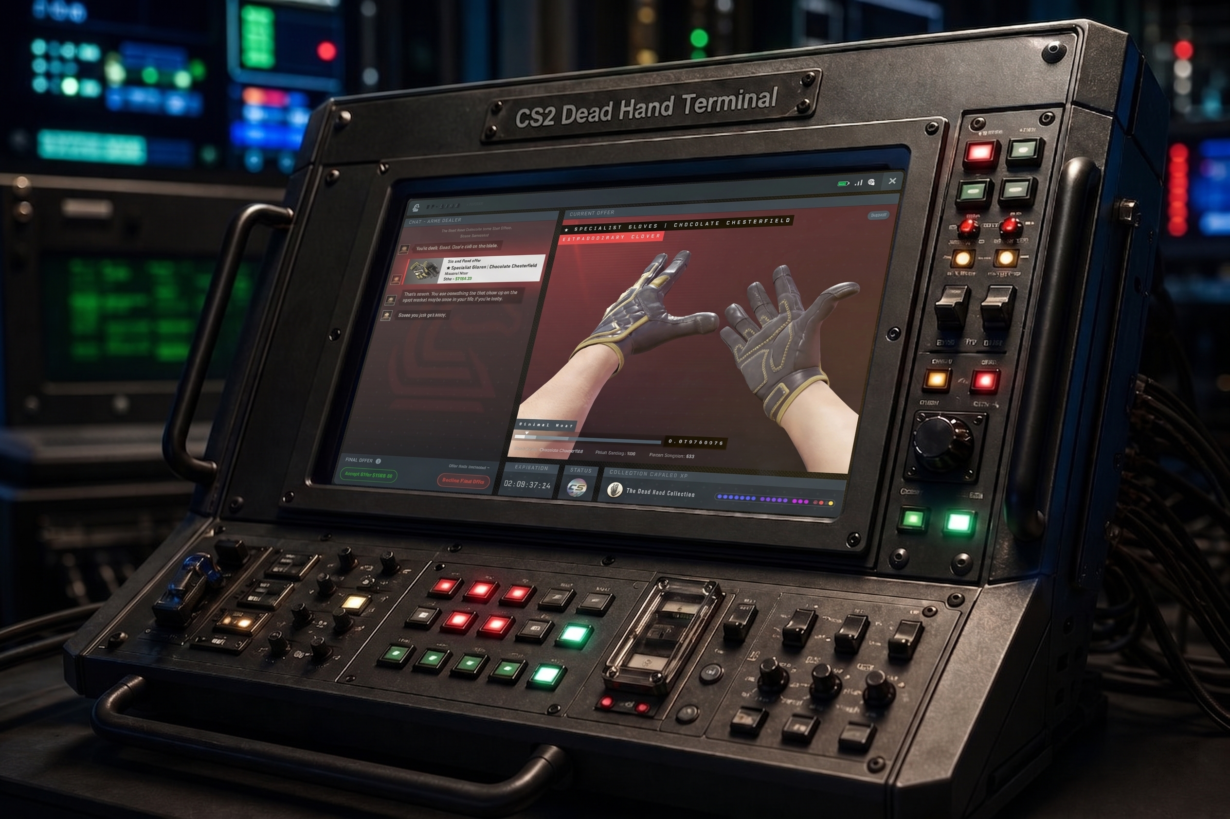
The unique terminal mechanic operates on a sequential offer system rather than a single random result. You open the terminal at no cost, receive up to five skin offers one at a time, and choose whether to purchase each one at a fixed price or skip it entirely. If you skip all five, the terminal breaks and you walk away with nothing.
How The Selection Mechanic Changes The Decision
With a classic case, your only decision point is whether to open it. Once the key is used, you receive whatever the RNG assigns. The terminal’s selection mechanic flips that model. Each of the five offers shows you a specific skin, its wear condition, and a purchase price before you commit any money.
This means you are not paying for randomness itself. You are paying for a specific item after seeing it. The practical effect is that low-value offers become easy skips. You only spend when the item’s purchase price sits below what you believe it is worth on the open market. That pass-or-buy dynamic is the core difference, and it fundamentally changes the expected value math compared to a standard case opening.
Every offer is still randomly generated from the Dead Hand Collection, so you cannot control what appears. You can only control whether you accept it. According to the Dead Hand Terminal guide on White Market, each terminal provides exactly five total attempts before it self-destructs, making each pass a permanent reduction in your remaining chances.
How Weekly Drops Deliver Terminal Rewards
You can receive a Sealed Dead Hand Terminal through CS2’s weekly care package system. As noted in the Steam Community drop pool guide, the Dead Hand Terminal entered the active drop pool on March 12, 2026, with an approximate 32 percent share of Prime drops. That means roughly one in three weekly drops for Prime Status players will be a Dead Hand Terminal, though this rate fluctuates as Valve adjusts the pool.
Prime Status is the gating requirement. If you do not have it, terminals will not appear in your weekly care package. You can also buy Sealed Dead Hand Terminals on the Steam Community Market from other players, though market prices fluctuate based on demand and the perceived value of the items inside.
The weekly drop itself costs you nothing beyond playtime. That zero-cost acquisition is important when calculating expected value, because your baseline investment is time, not money.
How It Compares With Other CS2 Reward Formats
CS2 now runs three distinct cosmetic acquisition systems in parallel: classic cases, the Armory, and terminals. Each format handles randomness, cost, and player agency differently, and knowing those differences helps you allocate your weekly drops and budget more effectively.
Terminal Drops Vs Classic Cases
A standard cs2 case requires a $2.49 key. You pay, you spin, you get one item with no option to decline. The rarity tiers determine your odds, and you accept whatever lands.
Terminals cost nothing to open. You see offers sequentially, and you only spend if an offer looks favorable. The tradeoff is that if nothing good appears across five rolls, you lose the terminal entirely. With a classic case, you always walk away with something, even if it is a $0.03 skin.
| Feature | Classic Case | Dead Hand Terminal |
| Key cost | $2.49 | Free to open |
| Offers shown | 1 (forced) | Up to 5 (optional buy) |
| Guaranteed item | Yes | No |
| Player decision | Open or sell | Buy, skip, or sell sealed |
| Gold-tier items | Knives | Gloves |
The terminal rewards informed decision-making. The classic case rewards volume. Neither is objectively better; they serve different player profiles.
Terminal Drops Vs The Armory
The Armory, introduced alongside the Fever Case and other updates, lets you pick specific items from a rotating catalog using Armory Stars. It is the most deterministic format in CS2, removing randomness almost entirely.
Terminals sit between cases and the Armory on the randomness spectrum. You get random offers, but you choose whether to act on them. The Armory gives you a fixed menu. The terminal gives you a random menu with a veto option.
Where the Armory excels at letting you target a known item, the terminal excels at offering potential access to ultra-rare items (like gloves) that the Armory does not stock. If you want certainty, use the Armory. If you want a shot at high-value gloves with downside protection from the pass mechanic, the terminal is the right format.
Why Three Parallel Formats Matter For Collectors
Having cases, terminals, and the Armory running simultaneously means you can spread risk. Spend your key budget on cases if you want guaranteed items. Save Armory Stars for targeted purchases. Use terminal drops as free lottery tickets where the pass mechanic limits your downside.
For collectors focused on completing the Dead Hand Collection, the terminal is the primary source, since these skins are exclusive to the Dead Hand system. After the initial seven-day trade lock, items begin appearing on the Steam Market, but the terminal remains the only first-hand source. Diversifying across all three formats keeps your portfolio flexible and your per-item cost under control.
What Is Inside The Dead Hand Drop Pool
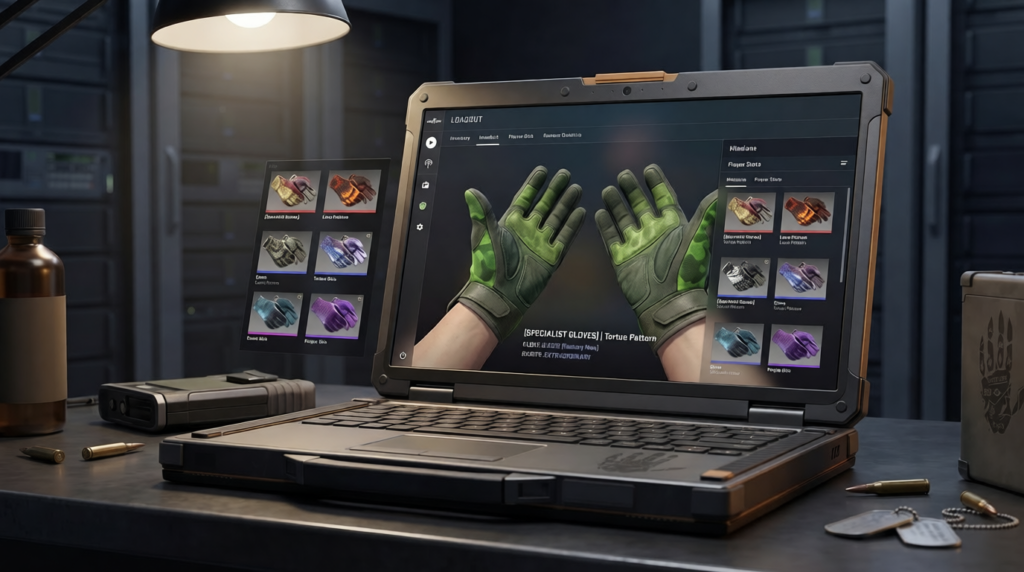
The Dead Hand Terminal draws from a pool of 39 total items: 17 weapon skins across standard rarity tiers and 22 gloves at gold rarity. That mix is what separates this terminal from the Genesis Terminal, which contained no gold-tier items at all.
Weapon Skins From The Dead Hand Collection
The 17 weapon skins span popular weapons including the AK-47, AWP, M4A1-S, Glock-18, Desert Eagle, MP9, and P90. Community artists designed these finishes, and they feature darker tactical aesthetics with metallic and muted color palettes. As Hellcase’s breakdown of the collection notes, the skins appeared in player inventories starting March 11-12, 2026.
Each weapon skin falls into one of the standard CS2 rarity tiers:
| Rarity | Color | Approximate Share of Offers |
| Mil-Spec (Blue) | Blue | Highest |
| Restricted (Purple) | Purple | Moderate |
| Classified (Pink) | Pink | Low |
| Covert (Red) | Red | Very Low |
| Gold (Gloves) | Gold | Extremely Low |
The lower-rarity skins dominate your five offers on most terminal opens. Expect blues and purples to fill the majority of slots.
CS2 Gloves And Why They Matter
The 22 dead hand gloves are the headline addition. As detailed by CSGOSKINS.GG’s special items listing, these are the first new glove finishes added to CS2 since 2020. Gloves sit at gold rarity, the same tier as knives in classic cases, and they command premium prices because of their visual impact and scarcity.
According to White Market’s probability guide, the chance of any single offer being gloves is approximately 1.29 percent. Across five offers, your cumulative probability of seeing at least one glove offer is still under 7 percent. Seeing gloves does not mean you can afford them, either; the purchase price within the terminal can be substantial.
This rarity is precisely what drives the Dead Hand Terminal’s speculative value. Most opens will show you nothing above purple. The rare glove sighting is where the real upside lives.
Rarity Tiers And Item Distribution
The drop rate data from Case-Sim confirms the distribution follows a steep curve similar to classic cases. Blue-tier items appear in roughly 80 percent of offers. Each step up in rarity cuts the probability significantly.
Here is an approximate per-offer probability breakdown based on available data:
| Rarity Tier | Per-Offer Probability |
| Mil-Spec (Blue) | ~80% |
| Restricted (Purple) | ~16% |
| Classified (Pink) | ~3.2% |
| Covert (Red) | ~0.64% |
| Gold (Gloves) | ~0.26% |
These numbers mean your five offers will most likely consist of blues with an occasional purple. Pinks are uncommon, reds are rare, and gloves are genuinely exceptional. Knowing this distribution before you open keeps your expectations grounded.
Expected Value And Realistic Outcomes
Calculating expected value for a Dead Hand Terminal is more nuanced than for a classic case, because the pass mechanic lets you filter out bad offers. Your EV depends not just on drop odds but on how wisely you use your five passes.
How To Estimate Expected Value From Live Prices
Start by pulling current Steam Community Market prices for every item in the Dead Hand Collection. Multiply each item’s market price by its per-offer drop probability, then sum those products. That gives you the raw expected value per offer.
For a rough EV table at approximate mid-2026 prices:
| Rarity Tier | Avg. Market Value (est.) | Per-Offer Probability | Contribution to EV |
| Mil-Spec (Blue) | ~$0.10-$0.50 | ~80% | ~$0.08-$0.40 |
| Restricted (Purple) | ~$0.50-$2.00 | ~16% | ~$0.08-$0.32 |
| Classified (Pink) | ~$5-$15 | ~3.2% | ~$0.16-$0.48 |
| Covert (Red) | ~$20-$80 | ~0.64% | ~$0.13-$0.51 |
| Gold (Gloves) | ~$50-$1,500+ | ~0.26% | ~$0.13-$3.90 |
The gold tier creates enormous variance. A single pair of desirable Factory New gloves can be worth hundreds or even over a thousand dollars, but you will see that offer in fewer than 1 in 100 terminal opens. The raw EV per offer lands somewhere in the $0.60-$5.60 range depending on current glove prices, and across five offers, you get five independent shots at that distribution.
Prices shift constantly. Experienced traders often compare Steam prices with various third-party marketplaces to find the best deals. Always check live market data on CSMarketCap before making decisions.
How Passing Affects Realistic Return
Here is where the terminal format creates a genuine edge over cases. You are not forced to accept a $0.05 blue skin. You skip it and move to the next offer. This selective behavior raises your realized return above the raw statistical EV.
Think of it as a filter. If you set a personal threshold, say, “I will only buy if the item’s market value exceeds the terminal’s purchase price by at least 30 percent,” you eliminate the worst outcomes. Your expected return conditional on actually purchasing becomes significantly higher than the unconditional average.
The catch: if all five offers fall below your threshold, you walk away empty-handed. The more aggressive your filter, the more often you lose the terminal entirely. Finding the right threshold is a balancing act between selectivity and utilization rate.
Costs, Opportunity Cost, And Liquidity
If you received the terminal as a weekly drop, your direct cost is zero. Your only expenditure is the purchase price of the skin you choose to buy inside the terminal. This makes the EV calculation simpler, since you are comparing the item’s market resale value against its terminal purchase price.
If you bought the Sealed Dead Hand Terminal on the market, you need to factor that acquisition cost into your break-even analysis. A terminal purchased for $2.00 on the Steam Market means you need to find an offer inside that generates at least $2.00 in profit after Steam’s 15 percent seller fee just to break even.
Opportunity cost also matters. You could sell the sealed terminal immediately for guaranteed cash. Every moment you hold it, you are betting that opening it will yield more than the sealed market price. For most casual players, selling the sealed terminal is the lower-variance play. For players who enjoy the process and can afford the downside, opening is where the upside lives.
Liquidity is another factor. Lower-rarity Dead Hand skins may take time to sell on the Steam Market. Gloves sell quickly. If you pull a blue skin from the terminal, you might sit on it for days waiting for a buyer, while the sealed terminal would have sold instantly.
Open, Pass, Or Sell
The right decision depends on your financial situation, risk tolerance, and whether you care more about guaranteed value or upside potential. There is no single correct answer, but the math points in clear directions for different player types.
Who Should Take The Drop
Open the terminal if you meet these criteria:
- You received it as a free weekly drop (zero sunk cost).
- You have enough Steam Wallet balance to purchase a mid-tier or higher skin if one appears.
- You enjoy the Dead Hand Collection’s aesthetics and would actually use the skins.
- You understand the glove odds are under 7 percent across five offers and are comfortable with that.
If you are a collector targeting specific Dead Hand skins, the terminal is the cheapest entry point since there is no key cost. The guide on SteamAnalyst recommends checking market prices before each offer to make sure the terminal price is actually competitive.
When Passing Makes Sense
Pass on opening if:
- The sealed terminal’s market price exceeds what you would realistically extract from five random offers.
- You do not have Steam Wallet funds to purchase a skin if a good offer appears.
- You would rather have guaranteed, liquid value right now.
Selling the sealed terminal is essentially converting variance into certainty. If the sealed price is sitting at $2-3 and your realistic expected gain from opening (accounting for your pass threshold and the odds of seeing nothing worth buying) is lower than that, selling is the rational play.
Also consider this: if you are the type of player who values gaming skins across multiple titles, platforms like Rewardly let you earn toward CS2 skins, gift cards, and other rewards through surveys and tasks without risking any of your Steam Wallet balance. That kind of parallel earning can fund your skin purchases without touching your terminal budget.
A Clear Verdict On Is It Worth It
For free weekly drops, opening is worth it as long as you have wallet funds ready and the discipline to skip bad offers. The zero acquisition cost means any profitable purchase is pure upside.
For purchased terminals, the math is tighter. You need the sealed price to be low enough that the probability-weighted value of your selective purchasing clears your break-even after fees. At current market prices, purchased terminals are a marginal play for most players unless you have a very refined pass/buy strategy.
For pure profit seekers, selling sealed is almost always the cleaner trade. You eliminate variance, lock in a known return, and free up capital for other opportunities.
The Dead Hand Terminal is not a get-rich-quick container. It is a format that rewards patient, informed decision-making. Treat it like a free option with five chances to exercise, not a slot machine, and you will extract more value from it than most players do.
Frequently Asked Questions
What is the Dead Hand Terminal item and how do you get it in CS2?
The Dead Hand Terminal is a container in CS2 that presents you with up to five randomized skin offers from the Dead Hand Collection. You can obtain it through the weekly care package drop system if you have Prime Status, or you can buy a Sealed Dead Hand Terminal from other players on the Steam Community Market. Opening it is free, but purchasing the skins shown inside costs Steam Wallet funds.
When was the Dead Hand Terminal introduced and when does it drop in CS2?
Valve introduced the Dead Hand Terminal on March 11-12, 2026, as part of The Dead Hand Update. It drops as part of the weekly care package for Prime Status players and currently holds approximately 32 percent of the active Prime drop pool. You can receive one each week through normal gameplay.
How much does a sealed version typically cost and what affects its price?
Sealed Dead Hand Terminal prices fluctuate on the Steam Community Market based on supply from weekly drops and demand driven by the perceived value of the items inside. Prices tend to be higher shortly after release and during periods when glove prices spike. Check current listings directly on the Market before buying, since even small price swings can change whether opening or selling makes more sense.
Is it worth opening a sealed version versus selling it unopened?
If you received it for free from a weekly drop and have wallet funds to purchase a good offer, opening is generally worth the attempt. If you bought the terminal on the market, you need the expected value of your selective purchasing to exceed your acquisition cost plus Steam’s seller fee. For risk-averse players, selling sealed locks in a guaranteed return with no variance.
Where is the safest place to buy or sell it, and how do you avoid scams?
The Steam Community Market is the safest venue because transactions are handled entirely within Valve’s ecosystem. Third-party marketplaces like those listed on SteamAnalyst can offer lower prices but carry additional risk. Avoid peer-to-peer trades with unknown users, never click suspicious trade links, and verify that any third-party site uses Steam’s official API for authentication.
What are the differences between its variants (wear, patterns, or special attributes) and how do they impact value?
The Sealed Dead Hand Terminal itself has no wear or pattern variation; it is a commodity item where every sealed unit is identical. The skins inside the terminal come in standard CS2 wear conditions (Factory New, Minimal Wear, Field-Tested, Well-Worn, Battle-Scarred), and higher-condition items command better prices. Gloves follow the same wear tiers. Factory New gloves from the Dead Hand Collection are the highest-value items in the pool and can trade for significantly more than lower-wear versions of the same finish.