
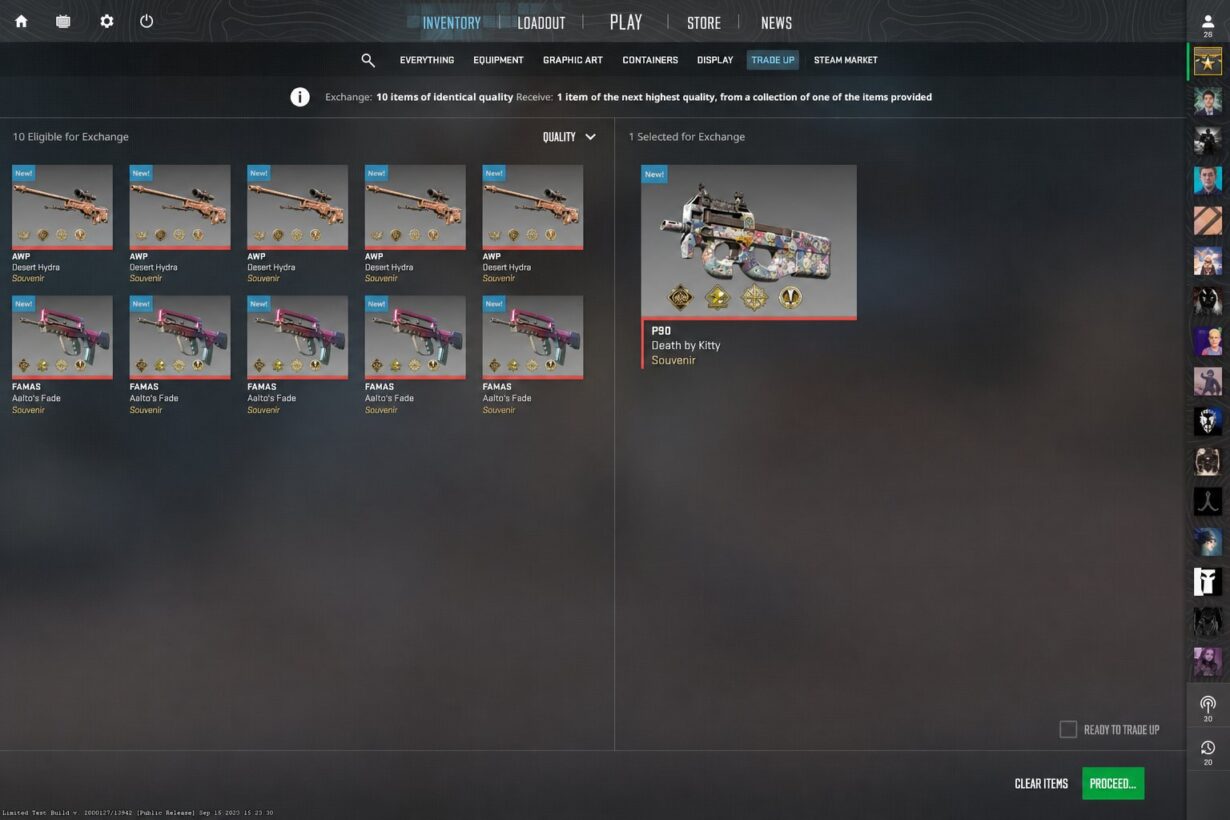

Valve’s May 22, 2026 update for IEM Cologne changed the CS2 economy in a way that years of speculation never quite predicted: CS2 souvenir trade ups can now be performed using souvenir skins within trade-up contracts. That single patch note turned forgotten inventory clutter into legitimate fuel and sent prices rippling across every rarity tier, from three-cent consumer grades to four-figure classified skins.
The core mechanic is simple: you feed souvenir skins into a trade up contract, all souvenir attributes get stripped, and the output is always a normal-quality item one rarity tier higher. No souvenir Dragon Lores are coming out the other side. That distinction between collectible souvenir value and trade-up input value is the single most important concept to grasp before you make any decisions with your inventory. Pair that with the new Souvenir-O-Matic (which lets you stamp any normal skin into a souvenir) and the permanent discontinuation of souvenir packages, and you have a fundamental restructuring of how souvenir skins fit into the CS2 economy. If you are looking for ways to earn toward CS2 skins without depositing real money, platforms like Rewardly let you complete surveys and tasks for coins redeemable for skins at Steam Market value, which can be a practical way to stock up on trade-up inputs.
Key Takeaways
- Souvenir skins now function as trade-up inputs, but every souvenir attribute is removed and the output is always a normal-quality item.
- Low-tier souvenir prices surged overnight while high-end souvenir collectibles dipped from panic selling, though the math suggests limited long-term supply impact at upper rarity tiers.
- Discontinued collections with capped souvenir supply, like Cobblestone and the 2021 Dust 2 Collection, carry the most interesting trade-up dynamics heading into the rest of 2026.
What Changed in May 2026
The IEM Cologne 2026 update on May 22 introduced three interconnected changes that reshaped the souvenir landscape: CS2 trade ups now allow souvenir items inside trade-up contracts, the Souvenir-O-Matic replaced the old package drop system, and souvenir packages were permanently discontinued. Each piece matters on its own, but together they redefined what souvenir skins are for.
How Souvenir Inputs Now Work
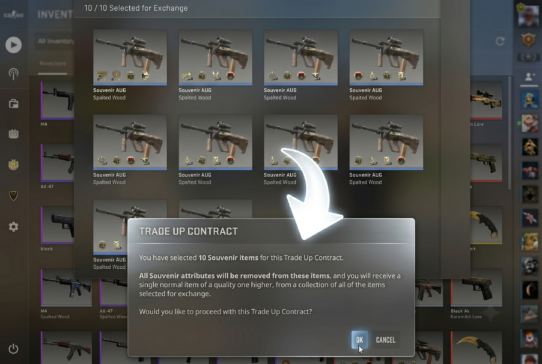
Valve’s patch notes were a single paragraph, but the rules are clean. You can select souvenir-quality items alongside normal-quality items in any trade-up contract. When you do, every souvenir attribute, including gold text, tournament stickers, and the souvenir tag, is stripped from the inputs. The output is always a normal item one rarity tier higher, drawn from the collections of all ten inputs.
The in-game confirmation dialog now shows how many souvenir items you have selected and warns that all souvenir attributes will be removed. So if you load ten Souvenir M4A1-S Knights into a contract, you receive a normal AWP Dragon Lore, not a souvenir one. That distinction is critical. As CS2 Central’s breakdown explains, the output quality is locked to normal regardless of how many souvenir inputs you use.
Standard trade-up rules still apply: ten inputs of the same rarity, output from the pooled collections, and the usual float calculation. Nothing about the core contract logic changed. The only new variable is that souvenir skins are now eligible inputs.
What Happens to Souvenir Attributes
This is where the update separates collectible value from input value. A Souvenir AWP Dragon Lore signed by a star player at a historic Major retains every bit of its collector premium because you cannot create one through trade-ups. Souvenir attributes only get destroyed on the input side. They never appear on the output side.
That means existing high-end souvenir items, the ones with rare tournament stickers and desirable player autographs, occupy a market lane that trade-ups literally cannot touch. The panic selling that hit souvenir Dragon Lores and Desert Hydras in the first 24 hours reflected fear, not mechanics. When you run the actual numbers on how many low-tier souvenirs it takes to produce a single classified or covert output, the supply math simply does not support a flood.
How Souvenir-O-Matic Changed Supply
On the supply side, the Souvenir-O-Matic introduced an entirely new creation path. You pick any normal weapon skin in your inventory, select a completed Major match, choose a player autograph, and the skin gets converted into a souvenir with gold text and tournament stickers. This requires a Cologne 2026 Viewer Pass and tokens, with token pricing tied to player popularity.
Souvenir packages, the old random-drop mechanic from watching Major matches on GOTV or Twitch, are gone for good. Any unopened souvenir packages still sitting on the Steam Community Market are the last ones that will ever exist, and their prices roughly doubled within hours of the announcement.
The Souvenir-O-Matic means new souvenir versions of any skin can be crafted, but at a real cost. Popular player autographs like donk’s are expensive. This creates a natural floor: the cheapest souvenir conversions will use lesser-known players, while premium autographs command a steep premium. The old lottery system is dead. What replaced it is deterministic, which is why Valve likely made the move, as it sidesteps increasing regulatory pressure around randomized loot mechanics.
How Contracts Work With Souvenir Inputs
Trade-up contracts in CS2 follow the same mechanical rules they always have; souvenir inputs just broadened the pool of eligible skins. The rarity ladder, collection weighting, float math, and StatTrak restrictions all still govern outcomes. Understanding these four pillars is what separates a calculated trade-up from an expensive mistake.
Rarity Rules and Eligible Inputs
Every trade-up contract requires exactly ten input skins of the same rarity tier. The output is one rarity tier higher. The ladder runs Consumer Grade, Industrial Grade, Mil-Spec, Restricted, Classified, and Covert. Every mil-spec souvenir follows this path. Since the October 2025 update, a separate 5:1 path allows Covert-to-knife and Covert-to-glove trade-ups, but that channel follows its own rules and is not directly affected by souvenir inputs.
Souvenir skins slot into the standard 10:1 contract at whatever rarity tier they occupy. A Souvenir Consumer Grade skin works identically to a normal Consumer Grade skin for contract purposes. The only caveat: the output is always normal quality.
Mixing Collections and Outcome Odds
Each input skin belongs to a collection, and the output is drawn from the next-rarity-tier skins across all represented collections. If you use seven inputs from the Cobblestone Collection and three from the Mirage Collection, the contract has a 70 percent chance of producing a skin from Cobblestone’s next tier and a 30 percent chance of producing one from Mirage’s next tier.
This weighting is where strategy lives. You control the probability by choosing how many inputs come from each collection. A trade-up calculator like the one on CSMarketCap or CaseCalculator’s trade-up finder lets you model these odds before committing real inventory. With souvenir inputs now eligible, the total pool of affordable skins at lower rarity tiers expanded significantly, which means more potential combinations to evaluate.
Float, Wear, and Output Condition
The output skin’s float value is derived from the average float of all ten inputs, scaled to the output skin’s minimum and maximum float range. The formula is:
Output Float = (Average Input Float) × (Max Float − Min Float) + Min Float
This matters because wear condition (Factory New, Minimal Wear, Field-Tested, Well-Worn, Battle-Scarred) is determined by the output float. If you want a Factory New result, you need inputs with low enough floats to land the average inside the FN range for the target skin.
Souvenir skins from old Majors sometimes have unusual float distributions because they were unboxed from packages rather than crafted. That can work in your favor or against it depending on the specific skin. Always check the float of each input before locking it in.
StatTrak and Other Important Limits
StatTrak items cannot be mixed with non-StatTrak items in the same contract. This rule extends to souvenir inputs: you cannot combine StatTrak skins and souvenir skins in a single trade-up. A contract is either all-StatTrak (producing a StatTrak output), or it uses normal and/or souvenir inputs (producing a normal output). There is no way to generate a souvenir output or a StatTrak souvenir output through trade-ups.
As Tradeit.gg’s 2026 guide notes, the 5:1 knife and glove trade-up path also excludes souvenir inputs entirely. Only the standard 10:1 contract accepts them. Keep that in mind if you are eyeing Covert-tier souvenir skins and wondering about knife paths.
Collections That Matter Most
Not every collection reacted equally to the souvenir trade-up change. The collections worth paying attention to are the ones with high-value covert skins at the top of the chain, finite souvenir supply, and enough low-tier inputs to make the math interesting. Four collections stand out above the rest.
Why Cobblestone Still Dominates Attention
The Cobblestone Collection is the headline act because the AWP Dragon Lore sits at Covert. Every conversation about souvenir trade-ups eventually loops back to the Dragon Lore, and for good reason: it is one of the most expensive skins in the game, and the Cobblestone Collection has a deep souvenir pool from years of Major map rotations.
Here is the reality check. The supply math is brutal. Roughly 48,000 Souvenir Mac-10 Indigos (Field-Tested) exist at Consumer Grade. Run those through the full chain: 48,000 become 4,800 at Industrial, then 480 at Mil-Spec, 48 at Restricted, and roughly 4 or 5 at Classified. As CS2 Central calculated, the entire existing supply of low-tier Cobblestone souvenirs produces almost nothing at the top. And the output Dragon Lore would be normal quality, not souvenir, so existing Souvenir Dragon Lores remain untouched.
The Souvenir M4A1-S Knight at Classified is the real pressure point. People will trade Knights up chasing normal Dragon Lores, which means the Knight supply shrinks over time. That is a deflationary dynamic worth watching.
Mirage and Desert Hydra Paths
The Mirage Collection contains the Desert Hydra at Covert, another high-value target. Mirage was a staple of Major map pools for years, so its souvenir supply is substantial. That makes it one of the most heavily affected collections since the update.
The 2021 Mirage Collection specifically accumulated a large pool of low-tier souvenirs from frequent Major play. Prices on Consumer and Industrial Grade Mirage souvenirs spiked within hours. If you are considering a Mirage chain, factor in that input costs have already adjusted upward. The easy arbitrage window closed fast.
The 2021 Dust 2 Collection and Mid-Chain Value
The 2021 Dust 2 Collection deserves attention not for a single headline skin, but for its mid-chain dynamics. The M4A4 Red DDPAT at Restricted and other mid-tier skins became interesting nodes in trade-up paths once souvenir inputs entered the picture.
What makes the 2021 Dust 2 Collection different from Cobblestone or Mirage is its role as a mixing collection. Traders use skins from one collection to weight odds in a contract that targets a different collection’s output. Souvenir inputs from the 2021 Dust 2 Collection are now cheap enough (relative to normal skins of the same rarity) to serve as filler slots that tilt probabilities toward a more valuable collection’s outcome. That mid-chain utility gives the collection a floor of demand even though its covert skins are not Dragon Lore caliber.
Discontinued Collections and Supply Caps
Collections tied to maps no longer in the competitive pool, like Office, Assault, and St. Marc, have a permanently frozen souvenir supply. No new souvenirs will ever be created for these collections because the maps are not played at Majors, and the Souvenir-O-Matic requires selecting a completed Major match on the relevant map.
That frozen supply gives discontinued collections an asymmetric profile. Every souvenir input that gets fed into a trade-up is gone forever. There is no replenishment mechanism. Over time, the circulating supply can only decrease. If a discontinued collection contains a desirable trade-up target at a higher rarity, the input skins become progressively scarcer.
This is not a reason to panic-buy everything from old collections. Most of them contain mediocre skins at the top of the chain. But the ones that connect to valuable outputs through cross-collection mixing are worth tracking, because their input costs will trend upward as supply is permanently consumed.
Market Impact and Price Drivers
The price movements in the 48 hours after the May 22 update told a clear story: cheap souvenirs surged, expensive souvenirs dipped, and normal skins in popular trade-up paths wobbled. Each tier reacted for different reasons, and understanding those reasons is more useful than chasing the numbers themselves.
Why Low-Tier Souvenir Skins Repriced So Fast
Before the update, most Consumer Grade and Industrial Grade souvenir skins sat between $0.03 and $3 on the Steam Community Market. They had almost no utility. They were collectible curiosities at best, dead inventory at worst.
The moment trade-ups opened to souvenir inputs, every one of those skins became a functional trade-up component. Demand materialized overnight. Skins that were worth a few cents jumped to $5, $10, or even $50 depending on the collection. As one early analysis noted, a trader who bought 100 low-tier souvenirs at $2.50 each saw them sitting at around $50 each within 12 hours.
The movement of souvenir skin prices was fastest for collections with high-value covert targets because the trade-up path gave those low-tier skins real expected value for the first time.
Why High-End Souvenirs Reacted Differently
Souvenir Dragon Lores, Desert Hydras, and Knights all saw price drops in the first day. The fear was straightforward: if souvenir skins can be traded up, the market would flood with normal versions of top-tier skins, and the souvenir premium would collapse.
The panic was understandable but mechanically unfounded. Trade-up outputs are always normal quality. No new souvenir Dragon Lores can come from contracts. The existing supply of high-end souvenirs is untouched by this change. What can happen is that Souvenir Knights get consumed in Dragon Lore trade-ups, which actually reduces the Knight supply.
The short-term dip looks like traders selling to fund low-tier souvenir speculation, not a structural repricing. Whether that assessment holds long-term depends on how aggressively people trade up mid-tier souvenirs in the coming weeks.
How to Compare Steam and Third-Party Prices
Price dislocation between the Steam Community Market and third-party platforms like CSFloat, Skinport, DMarket, and Buff163 was massive during the first 48 hours. Steam prices moved first because most panic buying and selling happened there. Third-party listings lagged by hours.
If you are evaluating souvenir trade-ups, always compare prices across multiple platforms. Tools like CSMarketCap aggregate pricing from 20+ marketplaces in near real-time. Keep in mind that Steam charges a roughly 13 percent seller fee, while most third-party platforms charge between 2 and 5 percent. That fee difference changes your effective input cost and, by extension, the expected value of any trade-up you are modeling. During volatile periods like the post-update window, the cheapest inputs are almost always on the platform where sellers are most eager to liquidate fast.
Evaluating Risk Before You Trade Up

The excitement around souvenir trade-ups has created a dangerous temptation: the assumption that because souvenir inputs used to be cheap, the trade-ups must be profitable. That was true for a narrow window. It is not automatically true anymore. Before committing inventory, you need to think clearly about expected value, chain structure, and when the math tells you to walk away.
Expected Value Versus Collector Premium
A souvenir skin has two kinds of value. Its trade-up input value is determined by the expected value of the contract output minus all input costs and fees. Its collector value comes from the tournament, the player autograph, the gold stickers, and the scarcity of the specific combination.
When you use a souvenir skin as a trade-up input, you permanently destroy its collector value. If the collector premium exceeds the trade-up input value, feeding it into a contract is objectively a loss. This is especially true for souvenirs signed by popular players from historically significant Majors. Always check what a souvenir skin sells for as a souvenir before assuming its best use is as trade-up fodder.
A practical rule: if a souvenir skin’s market price is already higher than a normal skin of the same type at the same rarity, the market is pricing in collector premium. Using it as a trade-up input means you are paying extra for attributes you are about to destroy.
Building a Sensible Trade-Up Chain
A trade-up chain is a sequence of contracts where you start at low rarity and work your way up through successive 10:1 steps. With souvenir inputs now in play, you can build chains that start at Consumer Grade souvenirs and climb toward Restricted or Classified normal outputs.
The key to a sensible chain is modeling every step independently. Each link in the chain needs positive expected value on its own, or at least a clear justification for accepting negative EV at one tier to reach a profitable tier above it. Use a CS2 trade-up calculator to model each step with current prices. Do not assume yesterday’s prices hold; the souvenir market is still volatile.
Pay attention to branching risk. At each step, your contract can produce skins from multiple collections. If one outcome is worth $200 and the other is worth $5, you need to weight the odds carefully. A chain that looks profitable on average can still lose money most of the time if the variance is high and the valuable outcome has low probability.
When a Souvenir Trade-Up Is Probably a Bad Idea
A few scenarios where you should pause:
- Input costs have already caught up to normal-skin equivalents. If souvenir skins cost the same as or more than normal skins at the same rarity and collection, you gain nothing from using souvenir inputs. The arbitrage is gone.
- You are trading up a discontinued collection souvenir with a desirable autograph. That skin may appreciate as a collectible faster than any trade-up output would. Destroying it is irreversible.
- You are chasing a specific covert skin with low probability. A 10 percent chance at a Dragon Lore sounds exciting. A 90 percent chance at a $15 skin that does not cover your input costs is the other side of that coin. Be honest about variance.
- You have not accounted for the Steam tax. The roughly 13 percent seller fee on the Steam Community Market eats into margins hard, especially on mid-tier outputs. If your expected output value is only marginally above your input cost, the tax can flip the trade-up negative.
If you are earning toward CS2 skins through a platform like Rewardly, where skins are listed at Steam Market value with no markup, the cost basis for trade-up inputs is straightforward. But the same risk math applies regardless of how you acquired the skins.
Frequently Asked Questions
Can souvenir items be used in a trade-up contract?
Yes. As of the May 22, 2026 update, souvenir-quality items can be selected in trade-up contracts alongside normal-quality items. All souvenir attributes, including gold text, tournament stickers, and the souvenir tag, are stripped from the inputs, and the output is always a normal-quality item one rarity tier higher.
Which weapon finishes are eligible for trade-up contracts in CS2?
Any weapon skin from Consumer Grade through Classified can be used as an input, including souvenir versions of those skins. The output will be one rarity tier above the inputs. Covert skins can only be used in the separate 5:1 knife/glove trade-up path, which does not accept souvenir inputs. Knives, gloves, and agents cannot be used as inputs in the standard 10:1 contract.
Are souvenir skins tradable and marketable, and what restrictions apply?
Souvenir skins are tradable and marketable on the Steam Community Market and third-party platforms, subject to the same trade-hold periods as other CS2 items. The standard seven-day trade hold after acquisition applies. There are no special restrictions on souvenir skins beyond what applies to all CS2 weapon skins.
Do souvenir items have different trade-up outcomes compared to non-souvenir items?
The only difference is that souvenir attributes are removed during the contract. The output is always normal quality, never souvenir. Outcome odds, float calculations, and collection weighting all work identically whether your inputs are souvenir, normal, or a mix of both. You cannot produce a souvenir skin through a trade-up contract.
How do collections and rarities affect trade-up results for souvenir items?
Collections and rarities work the same way for souvenir inputs as for normal inputs. Each input’s collection determines which next-tier skins are possible outcomes, and the probability of each outcome is proportional to the number of inputs from that collection. For example, if seven inputs are from the Cobblestone Collection and three are from the Mirage Collection, there is a 70 percent chance the output comes from Cobblestone’s next rarity tier.
What are the main risks and costs to consider before attempting a trade-up using souvenir skins?
The primary risks are overpaying for inputs whose souvenir premium you are about to destroy, high variance from low-probability desirable outcomes, and the roughly 13 percent Steam seller fee eroding margins on outputs. You should also consider that discontinued-collection souvenirs have a permanently capped supply, meaning their collector value may grow over time. Using them as trade-up inputs is irreversible, so always compare the skin’s collector market price against its trade-up input value before committing.