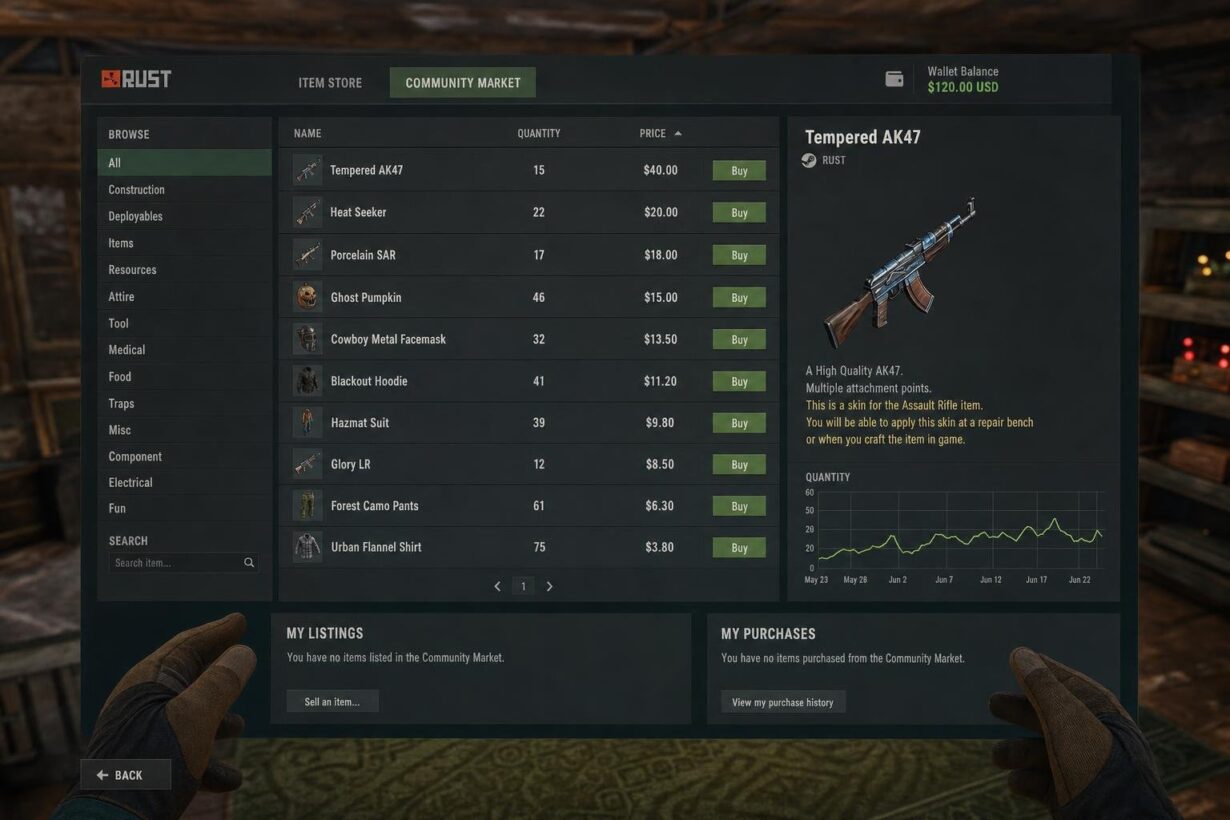

Rust skin investing 2026 revolves around one core mechanic that most players underestimate: the weekly Rust Item Store rotation. Many players overlook how investing in rust skins during these windows provides the highest potential for growth. Every Thursday, a fresh batch of community-created skins goes live for roughly seven days, then disappears from the official store permanently. That limited purchase window is where nearly all long-term profit potential originates, and understanding how to read each rotation is what separates consistent earners from speculators chasing hype on the Steam Community Market.
The strategy is straightforward: buy skins during their one-week store window at face value, hold through predictable seasonal demand cycles, and exit on the Steam Community Market or third-party marketplaces when the market value peaks. The challenge is identifying which skins from each rotation are worth your money and which will flatline. Factors like tactical utility, set cohesion, supply volume, rarity perception, and even charity-release status all influence whether a $1.99 door skin quietly appreciates to $8 or stays pinned at $2.50 forever.
This guide walks you through every stage of that process for 2026, from weekly store pattern recognition and winner identification to fee-aware exit planning and account security. Platforms like Rewardly, which lets you earn toward Rust skins without spending real money, give you a way to build a skin budget at zero financial risk. You can start earning Coins at rewardly.gg and redeem them for skins listed at Steam Community Market value with no markup.
Key Takeaways
- The weekly Rust Item Store’s limited purchase window is the single most important factor driving long-term skin appreciation.
- Tactical utility, set demand, supply volume, and charity-release status are more reliable valuation signals than community hype alone.
- Smart exit planning using price history, fee calculations, and seasonal demand cycles protects your margins better than chasing peak prices.
The Weekly FOMO
The Rust Item Store operates on a fixed weekly cadence that creates a predictable scarcity engine. Understanding this cycle is vital for anyone interested in investing in rust skins for long-term gains. Each rotation introduces new skins that can only be purchased at their listed price for approximately seven days, after which they leave the store and enter a secondary market defined entirely by supply and demand.
Why the Rust Item Store Window Creates Opportunity
The seven-day window caps total supply. Once the store rotates, no additional copies of that skin enter circulation unless Facepunch re-releases it, which is extremely rare. This means every skin you buy during its store window represents a fixed-supply asset.
Low initial sales volumes can actually work in your favor. A Lunar New Year skin rotation in early 2026, for example, showed noticeably lower subscriber counts and purchase numbers in the first 24 hours. When interest builds after the store closes, limited supply meets rising demand, and prices move.
What Happens After a Skin Leaves the Official Store
Once a skin exits the Rust Item Store, the only way to acquire it is through the Steam Community Market, third-party marketplaces, or direct trades. The market value is now set by what buyers are willing to pay and what sellers are willing to accept.
Price movement follows a general seasonal pattern. Prices tend to soften during March and April as the Rust player count dips. They then climb through June, July, and August when summer brings more players and more demand. Understanding this cycle helps you time both entries and exits.
Why Early Identification Matters More Than Chasing the Steam Market
By the time a skin starts trending on the Steam Market, early buyers have already locked in their positions at store price. Chasing a rising listing means you are paying someone else’s markup.
Your edge is in evaluating skins during their store window, before the secondary market sets a premium. That evaluation is the focus of the next section.
Identifying Winners
Not every skin in a weekly rotation is worth buying. The ones that appreciate consistently share a few observable traits: they offer in-game advantages, belong to a cohesive set, fall into high-liquidity item categories, or have supply characteristics that limit future availability.
Tactical Utility and Visibility Advantages
Skins that provide a competitive edge in gameplay tend to hold and grow in value better than purely cosmetic options. The most obvious examples are weapon skins and door skins with transparency features.
The Chinese Panel Wooden Double Door from the Lunar New Year 2 rotation in February 2026 demonstrated this perfectly. Its extreme transparency gave players a clear line of sight through a barricade. This type of “pay-to-win” utility drives demand regardless of the skin’s theme or holiday association.
Green-tinted armor skins that serve as camouflage in forested biomes follow the same logic. If a skin makes you harder to spot or gives you better information, players want it.
Set Hype, Theme Cohesion, and Collection Demand
Skins released as part of a themed set, such as Bambooque or holiday collections, benefit from collector behavior. When players buy one piece of a set, they often want the rest. This creates cross-demand that lifts prices across the entire collection.
Watch for sets that include both a weapon skin and a matching door or armor skin. Complete-set demand amplifies the value of each individual piece.
High-Liquidity Categories Like Weapon and Door Skins
Weapon skins and door skins are the two most actively traded categories in the Rust skin market. AK-47 skins, SAR skins, and wooden double doors consistently see the highest trade volumes.
Avoid over-investing in niche items like spinning wheels or decorative signs unless they have a unique first-of-its-kind feature, such as the glow-in-the-dark spinning wheel introduced in early 2026.
How Rarity and Supply Shape Long-Term Upside
A skin’s initial sales volume during its store window directly determines circulating supply. Low sales do not automatically mean failure. If the skin has desirable traits, low supply accelerates price appreciation once demand materializes.
Check subscriber counts and sales estimates within the first 24 to 48 hours. A skin that sells 5,000 units has a fundamentally different supply profile than one that sells 20,000.
The Charity Factor
Charity skins in Rust operate under different market dynamics than standard weekly releases. They carry an additional layer of community sentiment, limited-run perception, and sometimes unique visual features that alter both demand curves and holding behavior.
Why Charity Releases Behave Differently
Charity skins are typically tied to a cause or organization, and Facepunch often signals them as special-event items. This framing gives them an emotional premium that standard rotations lack.
Buyers of charity skins are often less price-sensitive. They purchased to support a cause, not to flip. This means fewer listings hit the secondary market early, tightening supply at precisely the time when interest is building.
How Community Goodwill Affects Demand and Holding Time
Charity items tend to have longer average hold times. Sellers feel social pressure not to immediately list a charity skin for profit, and many buyers equip them as a statement rather than treating them as inventory.
This holding behavior creates a slower, steadier appreciation curve compared to standard skins that often spike and dip within the first two weeks. Check the price history of past charity skins like those released through Trust in Rust events to see this pattern clearly.
When a Limited Charity Item Is Worth Buying Early
Buy during the store window if the charity skin has any of these traits:
- Tactical utility (transparency, camouflage)
- A unique visual feature not seen in standard skins
- Strong community buzz during the first 48 hours
- Low initial sales volume
If the skin is purely commemorative with no gameplay advantage and high initial sales, the long-term upside is more modest. You may still see slow appreciation, but it is unlikely to outperform a tactically useful standard skin from the same month.
Valuation, Fees, and Exit Planning
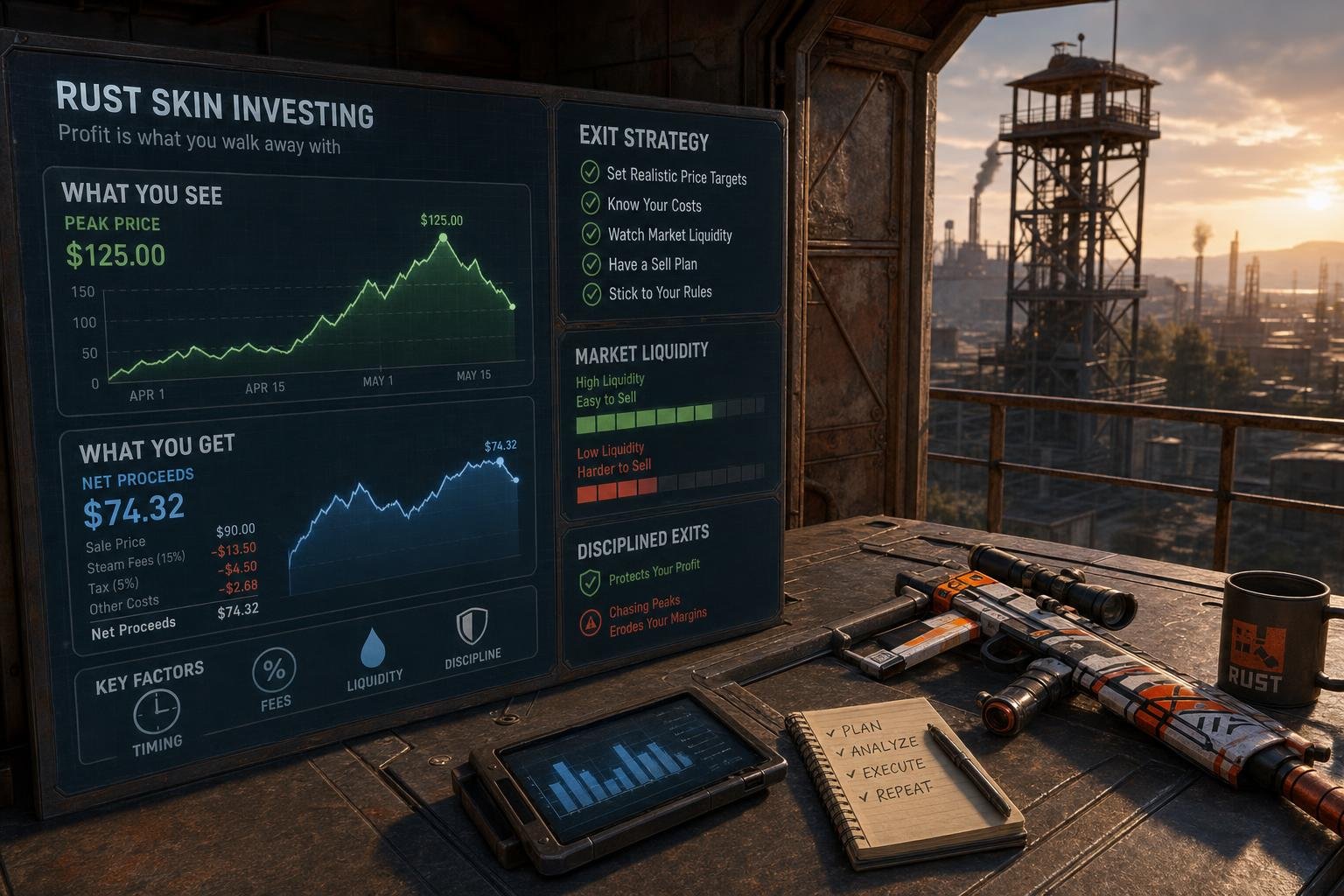
Profit in Rust skin investing is determined not by what a skin peaks at, but by what you actually walk away with after fees, timing, and liquidity constraints. Knowing when and where to sell rust skins is just as important as the initial purchase. Disciplined valuation and exit rules protect your margins far better than hoping for the perfect sell moment.
Using Price History Instead of Hype
Before buying any skin, review its price history on tools like SCMM, RustSkins.gg, or ItemAnalyst. Look for comparable skins from previous rotations that share similar traits (same item category, similar theme, comparable initial sales volume).
Price history tells you what the market actually paid, not what a Reddit post predicted. Use it to set realistic target prices for your holds.
Steam Fees vs Third-Party Marketplace Costs
The Steam Community Market charges approximately 15% in combined fees (Steam’s cut plus the game-specific fee). Third-party marketplaces like Skinport, DMarket, and Buff163 typically charge between 2% and 10%, but they come with trade restrictions, withdrawal delays, and varying levels of buyer protection.
| Platform Type | Typical Fee | Payout Speed | Buyer Pool Size |
| Steam Community Market | ~15% | Instant (Steam Wallet) | Very large |
| Third-party marketplaces | 2%–10% | 1–7 days (varies) | Medium to large |
| Direct peer-to-peer trades | 0% | Instant | Small, higher risk |
How to Set Entry, Hold, and Sell Rules
Establish rules before you buy:
- Entry: Only buy skins at store price during the rotation window. Do not chase aftermarket markups.
- Hold: Plan to hold through at least one seasonal demand peak (typically July or August). Minimum hold of 3 to 4 months for most skins.
- Sell: Set a target return (e.g., 2x store price after fees) and list when the skin reaches it. Do not wait for a theoretical maximum.
Why Liquidity Matters More Than Peak Price
A skin that peaked at $12 but has three buyers per week is harder to exit than a skin that peaked at $7 with fifty daily transactions. Always check recent sale volume on the Steam Market before committing capital. High-liquidity categories like AK-47 skins and wooden double doors let you exit on your terms.
Execution and Security Basics
Profitable Rust skin investing requires more than good picks. You must also understand the mechanics of the platforms where you buy and sell rust skins to avoid costly errors. A single account security lapse or a mishandled trade can wipe out months of patient holding. Getting your infrastructure right before your first purchase is non-negotiable.
Trade URL, Verification Process, and Account Setup
Your Steam Trade URL is the address other users and automated bots use to send you trade offers. You can find and reset it in your Steam privacy settings. Keep it current, and only share it on platforms you trust.
Complete Steam’s verification process, including adding a phone number and confirming your email. Without this, Steam imposes extended trade holds that delay every transaction.
Set your Steam inventory to public if you plan to use third-party marketplaces or price-tracking tools. A private inventory blocks these services from reading your holdings.
2FA, Escrow, and Common Trading Risks
Enable Steam Guard Mobile Authenticator (2FA) on your account. Without it, all trades are subject to a 15-day escrow hold. With it, trades confirm instantly.
Common risks to watch for:
- Phishing links disguised as trade offer notifications or marketplace logins
- Fake trade bots impersonating legitimate marketplace bots with slightly altered profile names
- Item switching during a trade window where a scammer swaps a valuable skin for a similar-looking lower-value item
- API key scams where malicious sites steal your Steam API key and intercept incoming trades
Review every trade offer carefully. Verify the exact item name, skin condition, and the sender’s profile before accepting.
When to Use Steam and When to Avoid Off-Platform Deals
The Steam Community Market is the safest venue for buying and selling, but its 15% fee structure eats into margins. Third-party marketplaces with escrow protection and verified seller programs offer lower fees and cash-out options.
Avoid direct peer-to-peer trades with strangers unless you are using a trusted middleman service. The risk of scams far outweighs the zero-fee advantage.
Where Rewardly Fits Into a Smart Skin Budget
Building a skin portfolio usually means spending real money. Rewardly offers an alternative path that removes financial risk from the equation entirely, letting you earn toward Rust skins through free actions on a platform designed specifically for gamers.
Using Rewardly to Earn Toward Rust Skins Without Deposits
On Rewardly, you earn Coins by completing surveys, offerwall tasks, watching videos, and referring friends. No real-money deposit is ever required. Those Coins convert at a flat rate of 1,000 Coins to $1 USD, with a minimum redemption threshold of just $5.
You can redeem Coins directly for Rust skins delivered through Steam’s official trade infrastructure. Skins on Rewardly are listed at Steam Community Market value with no markup, so the price you see is the price you pay in Coins.
Applying Market Discipline to Redemptions and Skin Picks
The same evaluation criteria you use for store-window purchases apply to your Rewardly redemptions. Do not redeem Coins for a skin just because it is available. Check its price history, liquidity, and tactical utility first.
Treat your Coins like capital. If a skin’s secondary-market trajectory looks flat, hold your balance and wait for a better opportunity. The Coins do not expire, so patience costs you nothing.
Why Rewardly’s Gamer Economy Perspective Adds Useful Context
Rewardly operates at the intersection of gaming rewards and market-value thinking. The platform’s transparent exchange rate, Steam-linked fulfillment, and no-markup pricing encourage you to evaluate every skin pick in terms of real value rather than impulse.
Approximately 70% of third-party revenue is passed through to users as Coins, giving you meaningful earning potential without the risks of skin gambling or paid loot boxes. It is a practical, low-risk tool for funding a diversified skin portfolio over time.
Frequently Asked Questions
What are the main factors to consider when investing in rust skins in 2026?
Tactical utility (transparency, camouflage), initial supply volume during the store window, item category (weapon and door skins trade most actively), set cohesion, and seasonal player count cycles are the primary drivers. These same factors influence the best time to sell rust skins for maximum profit. Skins with gameplay advantages and low initial sales tend to appreciate the most.
How can I evaluate a Rust skin’s liquidity and expected time to sell?
Check recent daily sale volumes on the Steam Community Market and cross-reference with third-party price trackers like RustSkins.gg or ItemAnalyst. AK-47 skins and wooden double doors consistently show the highest transaction frequency. If a skin has fewer than a handful of daily sales, expect longer listing times and less predictable pricing.
Which marketplaces are considered safest and most reliable for trading Rust skins in 2026?
The Steam Community Market remains the safest option due to Valve’s built-in buyer and seller protections. Third-party marketplaces such as Skinport, DMarket, and Buff163 offer lower fees and cash-out flexibility, but you should verify that each platform uses escrow, identity verification, and bot-authentication systems before listing.
What are the biggest risks and common scams to watch for when buying or trading skins?
Phishing links, fake trade bots with impersonated profiles, item-switching during trade confirmations, and API key theft are the most common threats. Always enable Steam Guard 2FA, verify every trade offer’s details manually, and never share your Steam API key with unfamiliar services.
How should I build a diversified skin portfolio across rarities, collections, and price tiers?
Spread your budget across two to three price tiers: low-cost skins under $2 for volume plays, mid-range skins in the $2 to $5 range for balanced risk and reward, and occasional higher-priced items (above $5) only when tactical utility or first-of-its-kind features justify the premium. Mix weapon skins, door skins, and one or two set pieces per rotation to avoid overconcentration.
What fees, taxes, and withdrawal limitations should I account for when calculating returns?
Steam’s combined marketplace fee is approximately 15%. Third-party marketplaces range from 2% to 10%. Always calculate your net return after fees before committing to a target sell price. In the United States, proceeds from skin sales may be considered taxable income; consult a tax professional if your annual skin trading volume is significant. Withdrawal to real currency is only available on third-party platforms, not directly through Steam.