

The Rust July 2026 wipe landed on July 2 and brought one of the most structurally significant changes the game has seen in years. This massive Rust update arrived with detailed alerts in the main menu notifications to help players navigate the new systems. The Common Ground update from Facepunch Studios introduced the Apartment Complex, a safe-zone monument where you can rent rooms, store loot, and set up player-run shops without ever placing a foundation. If you are used to the frantic scramble of early wipe, this patch rewrites a good chunk of the playbook.
Alongside the new monument, the update overhauled Softcore mode with a 2x gather rate from nodes and trees, introduced predictable raid windows, and rolled out a full clan system. Whether you are a solo weighing the risk of renting versus building, a duo looking to set up a scrap shop on wipe day, or a group trying to figure out how clan tags and team sizes interact with Softcore’s new pace, this guide breaks down the strategic consequences. You will find concrete advice on room tiers, shop economics, Softcore defense planning, and opening routes that actually account for the new meta.
What Changed On July 2, 2026
The Common Ground update is not a single feature drop. It is a package of interconnected systems that alter how you start a wipe. This rust apartment complex common ground update shifts the way players approach early game progression. Facepunch Studios bundled a new safe-zone monument, a clan framework, Softcore rule changes, and dozens of fixes into one patch, and the combined effect shifts early-game decision trees more than any single monument has before.
Why Common Ground Is A Bigger Meta Shift Than A Typical Monument Update
Most monument additions give you a new place to farm or puzzle through for loot. The Apartment Complex does something different: it gives you a place to live inside a safe zone. That distinction matters because it removes the single biggest barrier to early-game progression, which is the risk of losing everything before you have a base down.
In previous wipes, your first twenty minutes revolved around finding a quiet spot, getting a 2×1 down, and hoping nobody doorcamp you before you sealed the airlock. Now you can walk into the Apartment Complex, talk to the receptionist, rent a compact room for a small scrap cost, and immediately have a locked door with storage. Your loot is behind a safe-zone boundary, meaning no one can shoot you inside and no one can raid the room.
This changes the tempo of wipe day. Naked rushes toward build sites become less urgent. The pressure to craft a code lock in the first five minutes drops. You can farm, deposit, and re-gear from a protected position while you scout for a permanent base location. As BisectHosting’s breakdown notes, the update also includes rentable shops and the new clan system, meaning the Apartment Complex is not just shelter; it is a commerce hub and social anchor.
How The Rust July 2026 Wipe Reframed Early-Game Priorities
Before this patch, early-game priority order looked roughly like this: get a tool, hit trees, find a base spot, build, then start progressing. The Rust July 2026 wipe inserts a new step near the top: decide whether to rent.
If you rent early, you skip the base-building phase entirely for the first hour or more. Your scrap goes toward room rental instead of a workbench. Your inventory stays safe between farming runs. You trade building freedom for guaranteed protection.
If you skip renting, you still play the traditional game, but you now compete against players who are farming with zero base-maintenance overhead. They do not need to worry about honeycomb, sheet metal doors, or an airlock. They just deposit and go.
The Softcore 2x gather rate from nodes and trees amplifies this further. Faster resource income means you reach the scrap threshold for a room faster, and the predictable raid windows mean your traditional base is safe during off-hours anyway. The entire risk calculus for early-wipe play has shifted, and you need to factor in the Apartment Complex whether you plan to use it or not.
How The Apartment Complex Works

The apartment complex monument is a safe-zone location with rentable rooms, integrated shops, and NPC services. To improve the player experience, the computer station ui was updated to make interacting with the building’s cameras and security systems much easier. The specifics of room tiers, pricing, and layout determine whether renting makes sense for your playstyle and team size.
Where The Safe Zone Monument Fits Into Map Flow
The Apartment Complex spawns on procedurally generated maps and occupies a footprint comparable to a mid-tier monument. Its safe-zone boundary extends across the building and the surrounding grounds, including the attached shop row.
Because it is a safe zone, the same hostility rules that apply at Outpost and Bandit Camp apply here. You cannot draw a weapon or damage players inside the boundary. This provides a needed reprieve from the dangerous combat zones found throughout the rest of the map. This makes the monument a natural waypoint for early-game roaming, since you can pass through to heal or trade without the threat of being picked off.
Map flow changes meaningfully when the Apartment Complex sits between two high-traffic areas. It becomes a buffer zone where geared players and nakeds coexist, and the attached shops create a reason for mid-game players to revisit rather than bypassing it once they have a base. According to a Steam Community guide on the monument, the complex functions similarly to Outpost for safe-zone protections while adding the unique rental system on top.
What Rentable Rooms Include And Why That Matters
To rent a room, you approach the receptionist NPC in the lobby and pay a scrap fee. Once rented, the room is yours for a set duration, and you can extend the lease with additional scrap. The door is locked to your authorization, and your teammates can be added.
Each room comes with basic furnishings. You get a storage container, a sleeping bag spawn point, and enough space to place a small furnace or two depending on the room tier. This means you can smelt, store, and respawn inside a safe zone without ever placing a building plan.
The practical impact is significant. You do not need to farm wood and stone for a starter base. You do not need a code lock blueprint. You do not need to find a flat piece of terrain. You walk in, pay scrap, and you are operational. For players who lose gunfights early or play on high-pop servers where build spots near monuments get claimed in minutes, this is a reliable fallback that did not exist before.
Compact Rooms Versus Premium Penthouses
The Apartment Complex offers multiple room tiers. Compact rooms are cheap, costing minimal scrap, and provide the essentials: a locked door, a bag, and basic storage. They are small, with limited deployable space, but they get the job done for solos or duos who just need a secure stash point.
Premium penthouses cost considerably more scrap but offer larger floor plans, more storage, and room for additional deployables. If you are running a duo or trio, a penthouse gives you enough space to set up a proper staging area with multiple furnaces, a repair bench, and room to gear without stepping on each other.
The decision between tiers comes down to how long you plan to use the apartment as your primary base. If you are renting for the first hour while you scout a build location, a compact room is all you need. If you are planning to operate out of the Apartment Complex for a significant portion of the wipe, especially on Softcore where the pace is more forgiving, the penthouse is worth the extra scrap. As Corrosion Hour’s preview highlights, the Apartment Complex is one of the densest additions in recent memory, and choosing the right room tier is your first real strategic decision of the wipe.
Best Uses For Safe-Zone Housing
Renting a room is not universally the right move. The value depends on your playstyle, team size, server population, and how quickly you plan to transition to a traditional base. Knowing when to rent and when to skip it gives you an edge over players who default to one approach without thinking it through.
Who Should Rent Immediately On Wipe Day
Solos on high-pop servers benefit the most from an immediate rental. On a 300-player server, the first fifteen minutes are chaos. Build spots near monuments disappear fast, and getting doorcamped before you seal your base is a real risk. Renting a compact room eliminates that risk entirely. You pay a small scrap cost, get a safe spawn, and farm at your own pace.
New players and returning players who have not built muscle memory for speed-basing should also rent early. The Apartment Complex gives you breathing room to learn the map, check monument locations, and plan your real base without the pressure of losing a naked kit to a roofcamper.
Duos with mismatched schedules also gain a lot here. If your partner logs on two hours after you, having a shared apartment means they can gear up from stored resources instead of starting from scratch.
Storage, Furnaces, And Staging Without Base Exposure
One of the strongest advantages of apartment living is that your storage is invisible to other players. In a traditional base, experienced raiders can estimate your loot from your base size, your door count, and how often you come and go. An apartment gives nothing away. Nobody knows what you have stored inside.
You can also smelt ore inside your room without the telltale smoke that signals activity to neighbors. Place your furnaces, load them with metal ore and sulfur, and log off. Everything is behind a safe-zone barrier.
Use the apartment as a staging point for monument runs. Farm components at a nearby rad town, return to the complex, deposit what you need, and head back out light. You never carry more than one run’s worth of loot, which dramatically reduces the cost of dying.
When An Apartment Is Better Than A Traditional Starter Base
An apartment outperforms a traditional starter base in three specific scenarios. First, when you are on a server where your starter base would be raided within the first few hours regardless of design. Safe-zone protection makes the apartment immune to offline raids entirely.
Second, when you are playing Softcore mode. The 2x gather rate means you accumulate resources faster, and the predictable raid windows mean your eventual main base is safer during off-hours. The apartment fills the gap while you stockpile enough materials for a properly defended compound.
Third, when you are focused on trading. If your wipe strategy revolves around buying and selling through vending machines, the Apartment Complex puts you next to the shop row with zero commute. You can resupply your shop, adjust prices, and monitor foot traffic without ever leaving safe-zone protection.
An apartment is not better when you are on a low-pop server with easy build spots, when you need a base near a specific monument for farming, or when your team is large enough to defend a compound from day one.
The Scrap Economy Around Attached Shops
The Apartment Complex does not exist in isolation. Attached to the monument is a row of 14 rentable shop spaces where players can set up vending machines and sell items to foot traffic. This shop layer creates a micro-economy that did not exist at any previous monument, and it changes how scrap circulates during the first days of a wipe.
How The 14 Rentable Shops Change Local Trading
Before this update, player-run shops required you to build a base, place vending machines, and hope people found your location. The conversion rate on random-base vending machines was low. Most players walked past without checking.
The Apartment Complex shops fix the discoverability problem. All 14 shops sit in a high-traffic safe zone where players are already coming and going for room rentals, recycling, and NPC interactions. Foot traffic is built in. As GameScout’s coverage of the update explains, the rentable shops are designed to function as a player-driven marketplace attached to the monument.
If you rent a shop early and stock it with commonly needed items, like low-grade fuel, medical syringes, or components, you can generate passive scrap income while you farm elsewhere. The key is pricing competitively and restocking before your supply runs dry.
Scrap Costs, Foot Traffic, And Player-Run Market Opportunities
Renting a shop costs scrap, just like renting a room. You need to weigh that upfront cost against expected sales volume. On a busy server, a well-stocked shop near the lobby entrance can pay for itself within an hour. On a dead server, you are throwing scrap away.
The best shop items during the first day are consumables and early-game necessities. Bandages, cooked food, tools, and basic components sell quickly because players leaving the complex for farm runs want to gear up fast. Mid-wipe, transition to selling higher-tier items like gun bodies, tech trash, or pre-crafted weapons.
Price your items in scrap, not resources. Scrap is the universal currency, and players arriving at the monument already have it from barrel runs. Keep your margins thin early to build a reputation, then raise prices once competition settles.
Risks Of Relying On Monument Commerce For Progression
There is a real temptation to sit in your shop all day and play Rust like a trading simulator. That works up to a point, but it carries risks.
First, you are tethered to the monument. Every minute you spend restocking or adjusting prices is a minute you are not farming blueprints, running monuments, or progressing your tech tree. Shops are supplementary income, not a replacement for active play.
Second, shop inventory is not immune to the wipe cycle. If the server dies mid-wipe and population drops, your stocked vending machines sit unsold. You have invested scrap into rent and inventory with no return.
Third, competition among the 14 shops can crater prices quickly. If three players are all selling sulfur, margins collapse. Diversify your inventory or find a niche. Selling niche items like garage door blueprints, research components, or pre-crafted armor sets at reasonable prices often outperforms commodity trading.
Softcore’s New Progression And Defense Rules
The Common Ground update did not just add a monument. It fundamentally reworked Softcore mode into something that feels like a distinct game variant rather than a watered-down version of vanilla. The combination of faster gathering, scheduled raid windows, and the new Rust clan system creates a progression loop that rewards planning over raw aggression.
How 2x Gather From Nodes And Trees Speeds Recovery
Softcore now grants a 2x gather rate from resource nodes and trees. That means every stone node gives you double output, every tree drops twice the wood, and every metal node yields twice the ore. The effect compounds quickly.
You reach building material thresholds in half the time. A solo player can farm enough for a sheet metal 2×2 with honeycomb in a single focused run. You can stock a furnace with enough metal ore to smelt a full gear set before most vanilla players have their second floor down.
The recovery speed matters even more than the initial acceleration. Getting raided in Softcore stings less because you can refarm your losses in a fraction of the time. This shifts the psychological weight of raiding. Defenders lose less real time to setbacks, which keeps players on the server longer instead of rage-quitting after a raid.
As XP Gained’s patch notes summary details, the Softcore overhaul pairs this gather boost with structural changes to raiding and team play that make the mode feel intentionally designed rather than bolted on.
What Predictable Raid Windows Mean For Base Planning
Softcore now features predictable raid windows, specific time blocks during which raiding is permitted. Outside those windows, your base cannot be raided. This is a massive change.
For base planning, it means you can optimize for defense during a known timeframe rather than building to survive 24/7 attacks. You do not need to online defend at 3 AM. You do not need to set up auto turrets to cover every angle while you sleep. You build to survive the raid window, and the rest of the time your base is untouchable.
This changes how you allocate resources. Instead of sinking sulfur into excessive honeycomb and armored walls, you can invest more into workbench progression, weapon crafting, and monument runs. Your defensive spend becomes more efficient because you know exactly when threats can arrive.
It also means you can time your own raids strategically. Plan your sulfur farming around the window, craft your explosives in advance, and execute during the permitted hours. Raiding becomes a scheduled event rather than a random occurrence, which favors organized teams.
How The Rust Clan System And Team Sizes Interact With The New Pace
The new Rust clan system adds a formal structure on top of existing teams. You can create a clan with a clan tag, a shared chat channel, and organizational tools that make coordinating larger groups cleaner. The system is built around the clan table deployable, as covered in a breakdown by Shadowfrax.
In Softcore, where team sizes and raid windows create a more structured environment, clans let you assign roles effectively. Designate farmers, builders, PvP players, and shopkeepers. Coordinate raid-window defense rotations so not everyone needs to be online at the same time.
The interaction between clans and the 2x gather rate is worth noting. Larger clans accumulate resources at an absurd pace when every member benefits from doubled node output. A five-player clan farming nodes for thirty minutes can stockpile enough sulfur for a serious raid, which means raid windows on Softcore can still be intense despite the mode’s reputation as “casual.”
If you are a solo or duo, this means you need to plan your defenses with the assumption that organized clans will hit hard during raid windows. Use the Apartment Complex as a backup stash. Even if your base goes down, your apartment loot survives.
Practical Strategies For Solos, Groups, And Skin Chasers
The Common Ground update rewards players who adapt their opening moves to the new systems. A strong first hour looks different now than it did last wipe, and the strategic gap between informed players and those running old routines will be noticeable for the first few days.
A Strong Opening Route For Solos And Duos
On wipe day, spawn as close to the Apartment Complex as possible. Hit barrels along the way and prioritize scrap over components. Your first goal is reaching the receptionist and renting a compact room.
Once you have a room, deposit your sleeping bag and any early loot. Head out to farm nodes and trees. With each run, return to the complex, deposit resources, and head back out. You are farming with zero risk of losing accumulated loot because your storage is inside a safe zone.
After two or three runs, you should have enough scrap to either upgrade to a penthouse or start scouting a permanent base location. If the server is high-pop and you have already been killed twice, stay in the apartment longer. If the server is calm, transition to a traditional base near your preferred farming monument and use the apartment as a secondary stash.
For duos, coordinate your first runs in opposite directions. One partner farms north, one farms south. Both deposit at the apartment. You cover twice the ground and double your early resource income without doubling your risk exposure.
How Larger Teams Can Split Between Apartments, Shops, And Main Bases
Groups of three or more should split responsibilities immediately. Send one player to rent a penthouse at the complex. Send another to rent a shop space and begin listing early-game items. The rest of the team farms for a main base.
The penthouse serves as your team’s forward operating base for the first hour. All resources funnel through it. The shop generates passive scrap income that offsets the cost of room rental and supplements your main base fund.
Once your main base is down and secured, the apartment transitions to a backup role. Keep a sleeping bag active there and maintain a stash of emergency kits. If your main base gets raided during a Softcore raid window, your apartment inventory lets you regroup and rebuild without starting from zero.
The shop can run independently. Assign one team member to restock it periodically with surplus items. The scrap income adds up over multiple days and funds workbench upgrades, blueprints, and raiding supplies.
A Natural Way To Earn Rust Skins Outside The Wipe
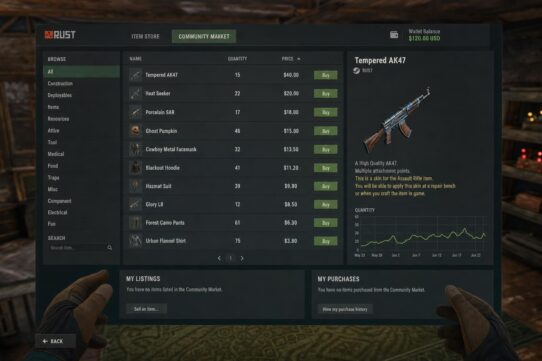
After a long wipe, you might want to freshen up your loadout with new skins but not feel great about spending money directly. If that sounds familiar, Rewardly offers a way to earn Rust skins through surveys, offerwall tasks, and referrals without depositing any real money. Skins are listed at Steam Community Market value with no markup, and the exchange rate is a flat 1,000 Coins per dollar across the board.
The platform works on a closed-loop system where you complete tasks and earn Coins, then redeem those Coins for skins delivered directly through Steam’s trade infrastructure. There is no luck-based mechanic involved in getting the skin you want; you pick it, you earn toward it, you receive it. The minimum redemption threshold sits at $5, which is reachable in a reasonable amount of time. Recent updates to the platform, including improved UI and quality-of-life features like @mention autocomplete in chat, make the experience smoother if you have not checked it out in a while.
It is a practical option for players who want to personalize their gear between wipes without pulling out a credit card.