


Matchmaking Rating, or MMR, is the core of the dota 2 mmr system. Understanding how mmr works is the first step toward climbing the ladder. It defines your position on the ranked ladder and determines which dota 2 rank you hold as you play. Engaging in dota 2 ranked matches is the only way to officially track your skill level.
This number goes up when you win ranked games and drops when you lose. The mmr system sounds simple on the surface, but the details beneath it, from calibration mechanics to behavior scores to Immortal leaderboards, can feel opaque if you haven’t been paying close attention.
This guide provides a comprehensive dota 2 mmr explained resource. We cover how the Dota 2 ranking system works, what each medal means, and how mmr recalibration treats different types of accounts. If you’re brand new, coming back after a long break, or just tired of guessing why your medal doesn’t seem to match your skill, you’ll find clear answers here.
For players who spend time in the Dota 2 ecosystem, platforms like Rewardly offer a way to earn Dota 2 skins and other gaming rewards for free through surveys, tasks, and referrals, no real-money deposits required. It’s built for the same community this guide serves: people who take their games seriously.
Key Takeaways
- Your MMR rises or falls by roughly 25 points per game, but a Glicko-based confidence layer introduced in Patch 7.33 can make swings larger during calibration or after inactivity.
- Dota 2 has eight medal tiers from Herald to Immortal, each with five stars (except Immortal, which uses a live regional leaderboard instead).
- Climbing consistently depends more on role specialization, behavior score, and disciplined session habits than on hero pool size or flashy plays.
How Ranked Matchmaking Works
The matchmaking system in Dota 2 pairs you with and against players of similar estimated skill. It uses your MMR as the primary sorting mechanism while layering additional factors like behavior score, role selection, and queue timing to refine match quality.
What MMR Measures In Practice
MMR is a number that represents the system’s best guess at your current skill in ranked games. Standard mmr gains are roughly 25 points per match. However, using a double down token allows you to risk twice the amount for a faster climb or a steeper drop.
That baseline has remained consistent for years.
What has changed is the math underneath. With Patch 7.33 in 2023, Dota 2 moved from a straightforward Elo-based system to a Glicko-2 model. This updated Glicko system adds a confidence layer known as rating deviation. When the system is highly confident in your rating, your MMR adjustments stay small and stable. When confidence is low, after a long break or during calibration, adjustments swing more aggressively to push you toward your actual level faster.
Your MMR is private. Only you can see the exact number.
How Visible Rank And Hidden Rating Interact
Your medal rank is what everyone else sees, but it’s not a perfect mirror of your current MMR. The medal reflects the highest MMR tier you’ve reached, and it doesn’t immediately drop back when you lose a few games. Small fluctuations within a tier won’t change your badge.
This means a player displaying an Ancient 3 medal might have lost enough MMR to be playing at Legend-level matches. The badge tells a story about your peak, not necessarily your present. Valve designed this partly to reduce the incentive for deliberate rank tanking, since your visible medal stays high even if your hidden number dips.
At the Immortal level, this system is replaced entirely by a live regional leaderboard, which updates in real time.
What Determines Match Quality Beyond Raw Skill
MMR does the heavy lifting, but it’s not the only variable. The matchmaking algorithm also tries to minimize the skill gap between the highest and lowest-rated players in a match, according to Dota 2’s matchmaking wiki. Queue time plays a role too: the longer you wait, the wider the acceptable skill range becomes.
Behavior score directly influences who you’re grouped with. Players with high scores get matched with other high-score players, which tends to produce more cooperative games. Players with low scores end up in a separate pool. We’ll cover behavior score in detail later, but the short version is: it matters for match quality as much as MMR does.
Time of day and regional server population also affect results. Queuing at off-peak hours on a low-population server naturally produces wider skill gaps in your matches.
Rank Medals And Star Progression

Dota 2 uses eight distinct Dota 2 ranks to represent your ranked standing, with stars subdividing most of them. Each medal corresponds to an approximate MMR range, and the star system tracks your progress within that range until you cross the threshold into the next tier.
Herald To Immortal At A Glance
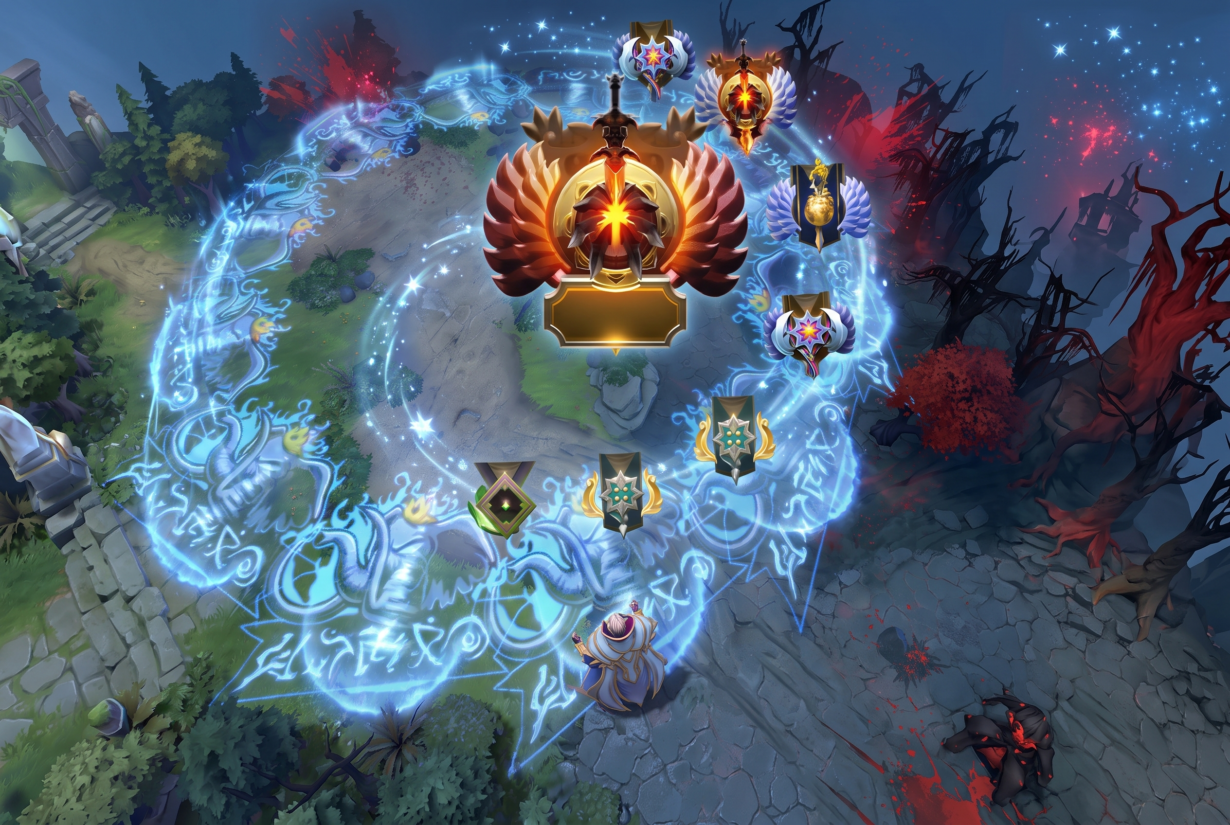
The eight ranked medals representing each skill bracket, from lowest to highest, are: Herald, Guardian, Crusader, Archon, Legend, Ancient, Divine, and Immortal. Based on community-tracked data from millions of accounts, here are the approximate MMR ranges:
| Rank | Approximate MMR Range | Player Base Context |
| Herald | 0 – 769 | Entry level; fundamentals still forming |
| Guardian | 770 – 1,539 | Basic mechanics understood, consistency lacking |
| Crusader | 1,540 – 2,309 | Role awareness developing |
| Archon | 2,310 – 3,079 | Objective play improving; most common rank (~22%) |
| Legend | 3,080 – 3,849 | Macro awareness, draft knowledge |
| Ancient | 3,850 – 4,619 | High-skill execution, vision control |
| Divine | 4,620 – 5,619 | Top ~8% of ranked players |
| Immortal | 5,620+ | Regional leaderboard; top players worldwide |
Valve does not officially publish fixed MMR cutoffs. These thresholds are community-observed estimates and can shift slightly with each season and region. Still, they’ve been remarkably stable over the past several updates.
More than 85% of active ranked players fall between Herald and Ancient. Reaching Divine already places you well into the top percentiles. The dota 2 rank distribution shows that the climb becomes significantly harder as you reach the tail end of the curve.
How Stars Work Within Each Medal
Each medal from Herald through Divine is divided into five stars. Each star represents an MMR increment of roughly 154 points through Ancient, and about 200 points in Divine. So climbing from Archon 1 to Archon 2, for example, requires gaining approximately 154 MMR.
Stars fill in as your MMR crosses the internal threshold. You can lose stars if your MMR drops below a tier boundary, though the system has a small buffer to prevent constant flickering between tiers after a single loss.
Your medal updates when you cross into a new star or a new tier entirely. It does not retroactively drop your medal badge below the highest tier you’ve achieved within the current season, even if your underlying MMR declines.
Why Immortal Follows Different Rules
Once you cross the approximately 5,620 MMR threshold and earn the immortal rank, the star system disappears. Instead, your rank is determined by a live regional leaderboard position. Immortal 200, for example, means you’re the 200th highest-rated player in your region at that moment.
Not every Immortal player gets a number. Only the top players within each region receive a visible leaderboard position. The rest display the Immortal badge without a numerical rank.
At this level, Valve has also redesigned how matchmaking assembles teams. Rather than simply sorting by MMR proximity, the system uses a captain-draft format where two captains select from a pool of eligible players. This makes drafting decisions and captain skill a direct factor in game outcomes at the highest tier.
Calibration For New And Returning Players

Calibration is how Dota 2 establishes or re-establishes your MMR when the system lacks confidence in your current rating. Whether you’re a first-time ranked player or someone returning after months away, the calibration process shapes your initial placement and can feel unpredictable if you don’t know what’s happening under the hood.
How First-Time Calibration Typically Works
Before you can play ranked at all, you need to meet two prerequisites: play 100 hours of unranked games and then complete 10 calibration matches. Those 100 hours aren’t just a gate; the system uses them to build a hidden MMR estimate before you ever queue for ranked.
During calibration, your wins and losses carry outsized weight compared to regular ranked games. The Glicko-based model starts with very low confidence in your rating, which means each game can swing your MMR significantly. A 7-3 calibration record will produce a meaningfully different result than a 4-6 one.
The system needs at least 30% rank confidence before it displays your medal publicly. Performance in unranked games before calibration does influence your starting point, so your first ranked placement isn’t truly random.
What Returning Players Should Expect
If you’ve been away for months or longer, your rank confidence decays during inactivity. The system becomes less certain that your old rating reflects your current skill. When you return, your first several matches will involve larger-than-normal MMR swings in both directions.
Reddit users and community reports consistently confirm this pattern. One player noted losing roughly 1,000 MMR after a year-long break despite going 8-2 in recalibration, illustrating that inactivity-driven decay is real and can be substantial. The system will eventually stabilize, but those first games back feel volatile.
Warming up in unranked before jumping into ranked recalibration is worth the extra time. Cold-queuing into calibration after a long absence tends to produce placements that don’t reflect your actual ability.
Why Early Matches Can Swing Faster Than Usual
The Glicko model intentionally makes early-match adjustments larger to accelerate you toward your true skill level. This is by design: the system prioritizes accuracy over stability when it’s unsure about you.
What this means practically is that your first 20-30 ranked games after calibration or a long break will feel more impactful than games played once your confidence is high. A win streak during this window can push you significantly higher than the same streak would later. A loss streak can drop you further, too.
Once confidence rebuilds, typically after a consistent stretch of games, your adjustments return to the standard ~25 MMR per match. Patience during this window matters; it’s not the time to panic about your medal.
Behavior Score, Conduct, And Queue Health
Your behavior score is a separate number that runs in parallel with your MMR, and it shapes the quality of your ranked experience in ways that many players underestimate. High-conduct players get matched with other cooperative players; low-conduct players end up in a pool that produces worse games regardless of mechanical skill.
How Conduct Affects Matchmaking Experience
Dota 2’s behavior score ranges up to 12,000 and directly determines your matchmaking pool. According to Liquipedia’s player behavior documentation, both your behavior score and communication score influence feature access, from post-game item drops to ranked queue eligibility.
Players with scores below 3,000 lose access to ranked entirely. Below 5,000, you can’t pause in-game. These aren’t cosmetic penalties; they fundamentally change what the game lets you do.
In practice, the difference between a 10,000 and a 7,000 behavior score is noticeable. Higher-score games tend to have more coordinated drafts, less abandoning, and fewer arguments over roles. The system essentially sorts you into a behavioral tier that affects game quality as much as your MMR bracket does.
Common Reasons Scores Rise Or Fall
Reports from other players are the primary driver of score decreases. Getting reported for communication abuse, intentional ability misuse, or feeding will lower your score. Abandoning games has one of the steepest penalties.
Your score rises passively by playing games without receiving reports and by being commended by other players. Consistently completing games to their conclusion, win or lose, also helps. The recovery curve is slow: rebuilding from a low score can take dozens of clean games.
One frequently overlooked factor is the communication score, which tracks chat and voice behavior separately from general conduct. Excessive pinging, mic spam, and chat toxicity all erode this number independently.
Why Communication Discipline Matters For Climbing
When you’re trying to gain MMR, wasting mental energy on arguments is a direct cost to your performance. Tilting a teammate with criticism rarely produces a comeback. Silence, or brief constructive pings, almost always outperforms lengthy chat debates.
From a systems perspective, keeping your behavior score high means you stay in the best possible matchmaking pool. Games with cooperative teammates give you more opportunities to execute strategy, which translates to more consistent wins over time.
The players who climb most efficiently tend to treat communication as a tool, not an outlet. Ping objectives, call Roshan timers, and mute liberally when someone is disruptive. Protecting your mental state is a climbing strategy, not just a personality preference.
Roles, Queue Choices, And Rating Nuance
Role selection in Dota 2’s ranked queue has gone through multiple iterations over the years, and the current system handles role-based rating differently than many players expect. The way you queue and the role you play influence both your opponents and your long-term consistency.
Whether Core And Support Ratings Still Apply
After the New Frontiers update (Patch 7.33), Dota 2 moved to a single unified MMR rather than maintaining separate core mmr and support mmr. Previously, you could have a significantly different medal for each role type. This change significantly impacted the role queue experience. This shift from separate role mmr and party mmr to a unified rating was a major change for the party queue and solo mmr players alike.
Your single MMR now applies regardless of which position you queue for. The system does apply per-role adjustments behind the scenes, meaning it tracks how well you perform in each position, but you won’t see a separate medal for support versus carry.
This change simplified the medal system but also means that if you’re a strong position 5 player who occasionally queues as a carry, your carry games are evaluated against the same MMR pool. The system expects you to perform at your overall rating level in every role.
How Role Selection Shapes Opponent Strength
When you queue with role selection enabled, you choose your preferred positions before searching. The system then builds teams where each player has a designated role. This reduces draft conflicts, but it also means that the opponents at your specific position may have specialized in that role while you might be filling.
Queue times vary by role. Support positions, especially positions 4 and 5, tend to find matches faster due to higher demand. Carry and mid roles often have longer waits. These queue time differences can subtly affect match quality, since longer waits sometimes mean wider MMR ranges in the resulting game.
Why Role Consistency Often Beats Flexing
Spreading your games across all five positions develops breadth, but it rarely builds the depth needed to climb. A player who masters positions 4 and 5 with three to four heroes each will typically produce more consistent results than someone rotating through every role each session.
The logic is straightforward. Every role in Dota 2 has unique timing windows, ward placement patterns, itemization priorities, and positional habits. Internalizing these for one or two roles lets you automate routine decisions and focus your attention on the parts of the game that actually decide wins at your bracket.
If you want to flex occasionally, unranked is the low-risk place to do it. Keep your ranked queue focused on the roles you know deeply.
Recalibration, Decay, And Seasonal Changes
Dota 2’s approach to seasonal resets and recalibration has shifted over the years. The current system no longer forces every player to recalibrate simultaneously, and decay mechanics work differently than many players assume.
When Recalibration Happens
Manual mmr recalibration can be triggered once per year from your account settings. There is no automatic seasonal reset that wipes everyone’s MMR at the same time, a change from earlier patches that used to force simultaneous recalibration on the entire player base.
When you choose to recalibrate, you play approximately 10-15 matches where the system treats your confidence as low, producing larger-than-normal MMR swings. The underlying MMR doesn’t reset to zero; it uses your existing rating as a starting anchor and adjusts from there based on calibration results.
Timing your recalibration matters. Starting calibration during a period where you’re playing well and have warmed up in unranked tends to produce better outcomes than recalibrating cold after a break.
How Inactivity Can Affect Placement Confidence
Even without manually triggering recalibration, extended inactivity causes your rank confidence to decay. This rank decay doesn’t directly lower your MMR number, but it increases the uncertainty the system attaches to your rating. When you return, your first games will produce larger MMR changes in both directions until confidence rebuilds.
The practical effect is that a long break can feel like a soft recalibration even if you never pressed the recalibration button. Going 5-5 after several months off might leave you with a lower MMR than you started with, because the system weighted early losses more heavily while it was reassessing you.
What To Verify With Live 2026 Data Before Publish
Note: Dota 2’s ranked system receives periodic updates, and specific details can change between patches. Before relying on any MMR thresholds, calibration match counts, or leaderboard rules as of mid-2026, confirm the following against current in-game data or official Valve communications:
- Whether the Glicko-based confidence system has received any tuning changes in recent patches.
- The exact number of calibration matches required (historically 10, but this has varied).
- Current seasonal timing and whether Valve has announced any 2026 ranked season structure changes.
- Whether the once-per-year recalibration limit still applies or has been adjusted.
Treat the information in this guide as accurate to the best available data at the time of writing, and cross-reference with patch notes when precision matters.
Immortal Leaderboard And Top-End Ranking
The Immortal bracket operates under fundamentally different rules than every other rank in Dota 2. Once you cross the MMR threshold into Immortal, stars disappear, medal progression stops, and your standing becomes a live competition against the best players in your region.
How Numbered Immortal Placement Works
Not all Immortal players receive a number. Only the highest-rated players in each region get a visible leaderboard rank, such as Immortal 1, Immortal 50, or Immortal 500. The rest carry the Immortal badge without a numerical position.
Your leaderboard rank updates in real time based on your current MMR relative to everyone else in the region. This means you can gain or lose positions without playing a single game, simply because another player in your region won or lost. It’s a dynamic ranking, not a static achievement.
To appear on the leaderboard at all, you typically need to have played a minimum number of ranked games within a recent window and maintain a sufficiently high behavior score. Valve has historically required a behavior score above a certain threshold for leaderboard eligibility, reinforcing that conduct matters even at the highest level.
Regional Leaderboards And Their Differences
Dota 2 maintains separate leaderboards for major regions: Europe, Americas, Southeast Asia, and China. You can browse the current standings on sites like Immortal Draft’s leaderboard tracker.
The MMR required to appear on the leaderboard varies significantly by region. Europe and China tend to have deeper competition, meaning a higher MMR is needed for the same numerical placement. In less populated regions, the leaderboard may be shorter, and the MMR threshold for entry can be noticeably lower.
This regional variance is worth knowing if you ever consider switching servers. A player who ranks Immortal 500 in one region might not even appear on the leaderboard in another.
Why Queue Population Changes High-MMR Outcomes
At the Immortal level, the player pool shrinks dramatically. During off-peak hours, there simply may not be enough Immortal players queuing to create a balanced 10-player lobby. The system handles this by widening the acceptable MMR range, pulling in Divine or lower-Immortal players to fill games.
This means high-MMR players often experience wildly inconsistent match quality depending on when they queue. Peak hours on a well-populated server produce the tightest, most competitive games. Late-night sessions on smaller regions can produce matches with a 1,000+ MMR spread between the highest and lowest-rated players.
For players approaching Immortal, queuing during peak hours on your region’s primary server is one of the simplest ways to ensure you’re getting fair, competitive matches that accurately reflect your skill.
Practical Ways To Improve Your Results
Climbing the ranked ladder is about maintaining a high win rate over many matches. It requires consistently executing fundamentals while managing the psychological side of competitive play. The players who gain rating most reliably tend to focus on a small set of high-impact habits. If you are looking for how to rank up fast, focusing on these specific areas will provide the most immediate benefit.
Last-Hitting And Lane Fundamentals
If you play a core role, your last-hit accuracy in the first 10 minutes is one of the strongest predictors of game outcome at every bracket below Divine. Missing creeps isn’t just lost gold; it’s a compounding disadvantage that affects your item timings, your team’s map control, and your ability to take fights.
Practice last-hitting in demo mode before queuing. Set a personal benchmark, say 60 creeps by 10 minutes on your main hero, and track it across your games. Small, consistent improvements here translate directly into MMR.
For supports, lane fundamentals look different: trading hits efficiently, pulling camps on the right timings, and knowing when to rotate versus when to stay. These decisions shape whether your carry gets a strong start or a punishing one.
Warding, Vision, And Map Information
Vision wins games, and it’s not exclusively the support’s job. At Archon and above, buying and placing one or two wards as a core player during the mid-game can provide information that prevents deaths and enables pickoffs.
Learning three or four reliable ward spots per side of the map is enough to meaningfully improve your vision game. You don’t need to memorize 50 positions. Focus on spots that reveal common rotation paths and Roshan pit approaches.
Checking the minimap every few seconds is a habit that separates players who climb from players who plateau. If you die and realize you didn’t look at the minimap in the 15 seconds before your death, that’s a concrete, fixable mistake.
Tilt Control And Session Management
Tilt is the single most common reason players lose MMR they shouldn’t. Two losses in a row don’t require a third game to “make it back.” They require a break.
A practical session structure that many climbing players use: set a daily MMR goal, such as +75 or +90, and a stop-loss of -50 to -75. When you hit either boundary, you stop for the day. This prevents extended loss spirals that can erase an entire week of progress in a single frustrated evening.
Playing ranked when you’re tired, distracted, or emotionally compromised is the least efficient use of your time. Save ranked for sessions where you can focus.
Review Habits That Actually Move The Needle
Watching your own replays is one of the fastest paths to improvement, but most players either skip it or watch without a framework. A more useful approach: after a loss, watch only your deaths. For each one, identify whether you had the information to avoid it and chose to ignore it, or whether you genuinely lacked vision.
You don’t need to review every game. One replay per session, focused on two or three specific deaths, gives you enough actionable feedback to adjust your play in the next match.
Watching high-MMR players who specialize in your hero or role can also help, but the key is watching with specific questions. “How do they position in fights at this timing?” is useful. Passively watching a stream for entertainment is not the same as studying.
Frequently Asked Questions
How does ranked matchmaking rating work and change after wins or losses?
Your MMR increases by approximately 25 points after a ranked win and decreases by roughly the same amount after a loss. The Glicko-based system introduced in Patch 7.33 adds a confidence variable that can make these adjustments larger or smaller depending on how certain the system is about your current skill level. After periods of inactivity or during calibration, swings can be noticeably bigger in both directions.
What MMR ranges correspond to each medal and rank tier in 2026?
As of the latest community-tracked data, the approximate ranges are: Herald (0-769), Guardian (770-1,539), Crusader (1,540-2,309), Archon (2,310-3,079), Legend (3,080-3,849), Ancient (3,850-4,619), Divine (4,620-5,619), and Immortal (5,620+). Valve does not publish official thresholds, and these numbers can shift slightly between seasons and regions. Each star within a medal represents roughly 154 MMR through Ancient and about 200 MMR in Divine.
How can I check my current MMR and track changes over time?
Your MMR is visible only to you on your Dota 2 profile under the ranked stats section. Third-party tracking tools like Dotabuff and OpenDota can record your match history and estimate MMR changes over time, but they rely on public match data being enabled in your settings. There is no official Valve API that exposes your exact MMR to external tools.
What is considered a good MMR for different skill levels and roles?
Archon (roughly 2,310-3,079 MMR) is the median bracket, meaning if you’re there, you’re right in the middle of the ranked player base. Reaching Legend puts you above roughly 60-65% of players. Divine (4,620+) places you in the top 8%. “Good” is relative to your goals, but consistently maintaining Legend or above indicates solid game knowledge and execution. Role doesn’t change the MMR scale since core and support ratings are now unified.
How does the rank distribution look across the player base right now?
Based on data from approximately 7.8 million tracked accounts, Archon is the most populated rank at roughly 22% of the player base. More than 85% of active ranked players fall between Herald and Ancient.
Immortal represents under 2% of all ranked players. The distribution forms a rough bell curve centered around Archon and Crusader. This dota 2 rank distribution is updated periodically by the community using public match data.
What MMR is typically needed to reach Immortal, and what are the highest MMR records?
The Immortal threshold sits at approximately 5,620 MMR based on current community data. Reaching a numbered Immortal position (such as Immortal top 100) requires significantly more, often 7,000+ MMR depending on the region and time of season. The highest recorded public MMR values have exceeded 13,000 in certain regions, though these numbers fluctuate as top players compete on the live leaderboard.
If you’re spending time in the Dota 2 ecosystem, you can earn Dota 2 skins for free on Rewardly by completing surveys, offerwall tasks, and referrals. Skins are listed at Steam Community Market value with no markup, and no real-money deposit is ever required. It’s a straightforward way to build your inventory while you grind MMR.